How to Adjust Grind Size for Flavor: A Field Manual
Last Updated: October 23, 2026
Quick Summary
To adjust grind size for flavor, change one variable at a time: grind finer if the cup tastes sour or weak, and coarser if it tastes bitter or dry. Move one click or small increment, brew again, and record the result until sweetness peaks.
- Finer particles expose more surface area, so water pulls flavor out faster; coarser particles slow extraction.
- French press and cold brew call for a coarse grind, drip a medium, pour-over medium-fine, and espresso fine.
- Lock your dose and water first, then name the flaw in one word before making a single grind change.
- Purge about 2-3 grams of coffee after each setting change to clear retention from the grinder.
- Fresh beans often want a slightly coarser grind, while aged beans usually want a finer one.
Table of Contents
- Why Grind Size Controls Flavor Extraction
- The Coffee Grind Size Chart: A Reference for Every Brew Method
- Coffee Grind Size for Different Brewing Methods
- How to Adjust Coffee Grind Size by Taste
- Coffee Grind Size for Espresso and Dialing In a Shot
- Separating Grind Problems from Other Brewing Variables
- Grinder Calibration, Retention, and Adjustment Limits
- Matching Grind to Bean Age and Roast Level
- Frequently Asked Questions
Why Grind Size Controls Flavor Extraction
Grind size is the single most powerful lever you control over how coffee tastes, because it sets how fast water can reach the flavor inside each particle.
Here's the field manual version: finer particles expose more surface area, so water pulls flavor out faster. Coarser particles slow that pull.
At Iron Soldiers Coffee Company, we treat grind like a rifle zero. You set it, you test it, you correct it, and you record what worked.
Particle Size, Surface Area, and Water Flow
Particle size is the average size of the ground coffee pieces. Smaller pieces mean more total surface area for the same weight of coffee.
More surface area means water extracts soluble flavor compounds faster. Fewer, larger pieces slow the whole process down.
Water also flows differently. A bed of fine particles packs tight and resists flow. A bed of coarse particles lets water pass quickly.
Fines, Boulders, and Grind Consistency
Fines are the tiny dust-like particles every grinder produces. Boulders are the oversized chunks that slipped through.
Both are problems. Fines over-extract and turn bitter while the rest of the bed is still under-extracted. Boulders under-extract and leave sour, hollow notes.
Grind consistency matters more than raw fineness. A uniform grind lets you make one clean adjustment. An uneven grind forces you to compromise because you're fighting two problems at once.
Pro Tip
If your coffee tastes bitter and sour in the same cup, that's usually a consistency problem, not an adjustment problem. No grind setting fixes an uneven burr set.
The Coffee Grind Size Chart: A Reference for Every Brew Method
A coffee grind size chart gives you a starting point, not a final answer. Use it to get close, then adjust by taste. Treat it the way you'd treat a map: the terrain still decides.
| Brew Method | Grind Range | Texture Reference | Typical Brew Time |
|---|---|---|---|
| French press | Coarse | Sea salt | 4 minutes steep |
| Cold brew | Coarse | Sea salt | 12-18 hours steep |
| Drip machine | Medium | Table salt | 4-6 minutes |
| Pour-over | Medium-fine | Fine sand | 2-4 minutes |
| Espresso | Fine | Powdered sugar | 25-30 seconds |
Two things to remember. First, these ranges shift with the bean, the water, and the brewer. Second, your grinder's numbers are not universal. A "12" on one grinder is not a "12" on another.
Coffee Grind Size for Different Brewing Methods
Each brew method has its own contact time, and grind has to match it. Steep methods want coarse. Fast methods want fine. Here's how that plays out in practice.
French Press, Drip, Pour-Over, and Cold Brew
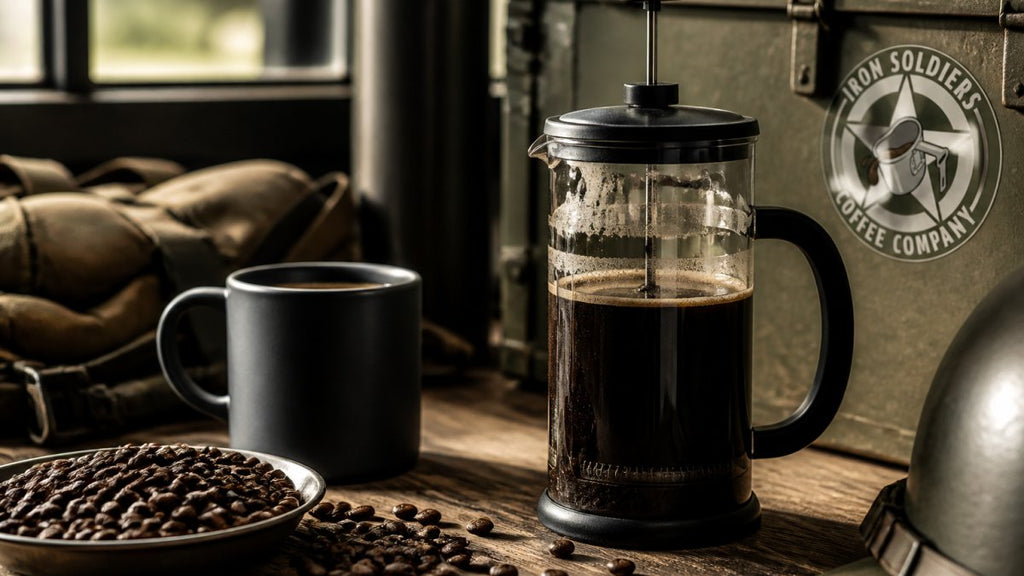
French press uses a long steep and a metal mesh filter.
Drip machines run water through a paper filter on a fixed schedule. Medium grind is the safe zone.
Pour-over gives you the most control and rewards a medium-fine grind. A grind that's too fine slows the drawdown and stalls the bed.
Cold brew steeps for hours, so coarse is the rule.
Watch Out
Don't chase an espresso grind in a drip machine. You'll clog the basket, stall the brew, and end up with a bitter pot you'll blame on the beans.
How to Adjust Coffee Grind Size by Taste
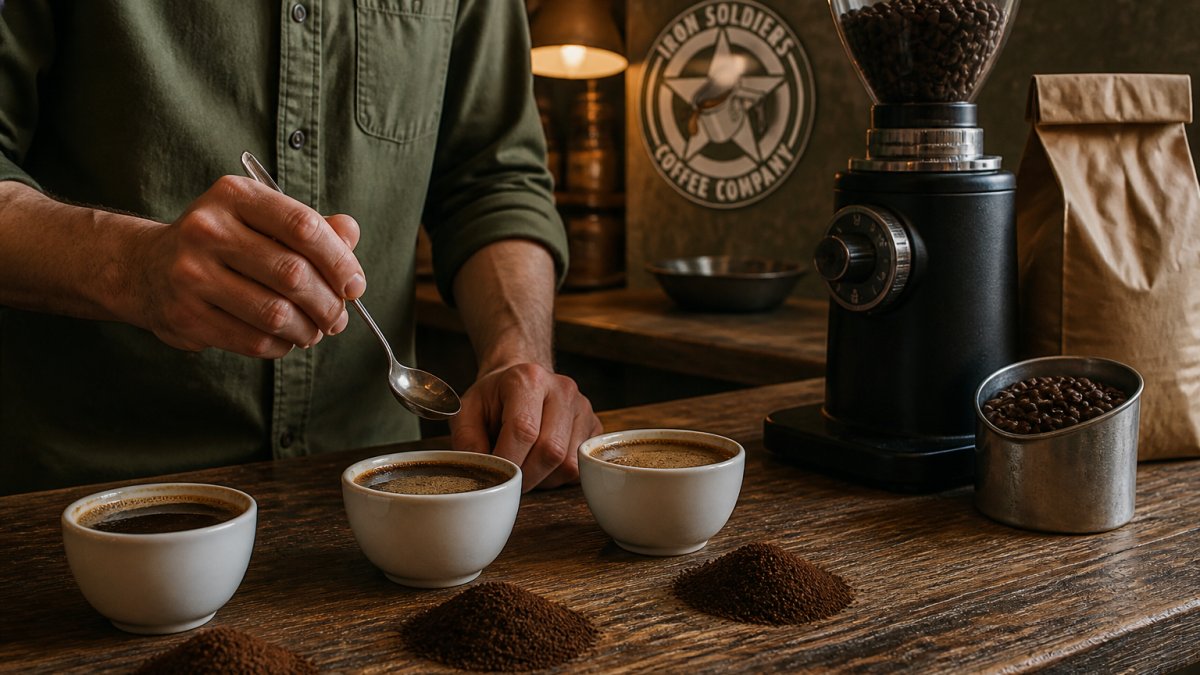
Learning how to adjust coffee grind size by taste comes down to one habit: taste first, then move one step. Your palate is the final gauge, and it's more reliable than any chart.
A Controlled Taste-Test Workflow
Treat each adjustment like a patrol: one variable, one report, one correction. Here's the sequence that most practitioners find reliable:
- Lock your dose. Weigh the same amount of coffee every time (a common starting point is 15-18 grams for a standard 8-ounce cup, but pick a number and stick to it).
- Lock your water. Use the same water weight and temperature each brew. A kitchen scale and a thermometer remove guesswork.
- Brew with your current grind setting. Record the setting number, total brew time, and your first taste impression.
- Name the flaw in one word. Sour, bitter, weak, harsh, dry, or balanced. Write it down.
- Make one grind change. Finer if sour or weak; coarser if bitter or dry. Move one click or one small increment.
- Brew again and compare. Did the flaw improve, worsen, or stay the same? Record it.
- Stop when sweetness peaks. The goal is a cup where sweetness and acidity balance, with no sharp edges.
This log becomes your field notes. After a few sessions, you'll see patterns, like "setting 8 runs 3:15 and tastes balanced with this bean", that no generic chart can give you.
Reading Sour, Bitter, and the Middle Cues
Sour or sharp usually means under-extraction. The water moved too fast to pull the sweetness out.
Bitter or dry usually means over-extraction. The water pulled too much out.
Watery or thin means the brew lacked body and strength.
Harsh or astringent (a drying, puckering sensation) often points to over-extraction of fines or too much agitation during brewing.
A useful middle cue: if the cup tastes flat but not sour or bitter, you're close.
Pro Tip
Keep a small notebook or a note on your phone with columns for date, bean, dose, water, grind setting, brew time, and taste. This is your after-action report, it turns guesswork into intelligence.
If bitterness is the main complaint, our guide on why coffee tastes bitter after brewing helps you confirm whether grind is the culprit or something else in the brew.
Coffee Grind Size for Espresso and Dialing In a Shot
Espresso grind size is the finest setting you'll use, and it's the least forgiving. A tiny change in particle size can swing a shot from sour to bitter. That's why dialing in is a process, not a guess.
A Repeatable Dial-In Workflow
Use the same steps every time so your results mean something.
- Set your grinder to a fine starting point
- Dose the same weight of coffee into the basket
- Tamp level and firm, the same way each time
- Pull the shot and note the time and taste
- If it runs fast and tastes sour, grind finer
- If it runs slow and tastes bitter, grind coarser
- Change one variable per shot, then repeat
Record your setting and result. After a few sessions you'll have a log that tells you exactly where to start with a new bag.
Key Takeaway
Dialing in works only if you change one thing at a time. Two changes at once and you learn nothing about either.
Separating Grind Problems from Other Brewing Variables
Grind gets blamed for a lot of flaws it didn't cause. Before you touch the collar, rule out the other variables.
Check these in order:
- Water temperature: too cool under-extracts, too hot over-extracts
- Coffee-to-water ratio: too little coffee tastes weak regardless of grind
- Brew time: a stalled or rushed brew changes extraction on its own
A common mistake is grinding finer to fix a weak cup that was actually under-dosed. You'll end up with a bitter cup and a wrong setting.
For a deeper walkthrough of the full picture, see our guide on how to improve coffee extraction quality at home.
Grinder Calibration, Retention, and Adjustment Limits
Your grinder is a precision instrument, and like any instrument it drifts. Retention, calibration, and adjustment limits are the three mechanical factors that can make your taste adjustments unreliable, and most grind guides skip them entirely. Here's how to bring your grinder back to zero.
Retention: The Hidden Variable
Retention is the amount of ground coffee left inside the grinder after you finish. Those old grounds come out in your next dose and throw off your adjustment. A grinder that retains 2 grams per dose can shift your effective grind setting by a full step without you touching the dial.
Practical fixes:
- Purge a small amount of coffee (about 2-3 grams) after each setting change.
- On hand grinders, brush out the burr chamber between brews.
- On electric grinders, use a bellows or give the grinder a gentle tap to clear the chute.
Calibration: Finding True Zero
Calibration matters because your grinder's numbers drift over time. The zero point, where the burrs just touch, can shift after cleaning or burr wear. If your notes say "setting 12" but the grinder now zeroes at a different point, your old settings are meaningless.
How to recalibrate:
- Empty the grinder completely.
- Run the burrs with the setting at its finest until you hear them just touch (a light chirp). That's your true zero.
- Note where the dial reads at that point. If it's not zero, adjust the calibration collar or mark the new zero with tape.
- Recheck after every deep cleaning or burr replacement.
Pro Tip
Write your grinder's zero point on a piece of tape on the counter. When settings start feeling off, you'll know whether the grinder moved or your memory did.
Stepped vs. Stepless: Knowing Your Limits
Stepped grinders click between fixed settings, so you may not be able to make the exact change you want.
Burr alignment is the last mechanical check. If your burrs are misaligned, you'll get inconsistent particle sizes no matter what setting you choose.
If you're pushing against those limits, our roundup of the best manual coffee grinders for consistency covers models that hold a setting well.
Matching Grind to Bean Age and Roast Level
Fresh beans and aged beans need different grinds. So do light and dark roasts.
Fresh beans release gas, which can slow water flow.
Aged beans have lost gas and pull flavor more slowly.
Light roasts are denser and harder to extract.
Dark roasts are more porous and extract easily.
For the full flavor picture, our breakdown of light roast vs dark roast flavor profiles explains how roast level shapes what you taste.
And since grind is really about extraction, our guide on performing a coffee bloom for better extraction is the natural next step once your grind is dialed in.
Grind adjustment rewards patience and record-keeping, not expensive gear.
When you're ready to put a fresh roast through its paces, Iron Soldiers Coffee Company offers blends, single origins, and flavored options built for daily drinkers and long shifts alike. Start with our African Espresso for a bold medium-dark roast, or work through the Single Origin Favorites Sample Pack to learn how different beans respond to your grinder.


Get started with Iron Soldiers Coffee Company and dial in a cup that's worth the effort.
Frequently Asked Questions
Why is my coffee grinder not grinding fine enough?
Most home grinders hit a floor before they reach true espresso fineness. Check three things first: whether the burrs are worn, whether the grind chamber is packed with old grounds, and whether the adjustment collar is already at its finest setting. If the burrs are dull, the grinder will produce inconsistent particle sizes rather than a clean fine grind. Clean the burrs, run a few grams through to clear retention, then test again. If the grind still will not tighten up, the grinder has reached its adjustment limit and the fix is a burr upgrade, not more twisting.
Should I grind coffee finer or coarser if it tastes sour?
Sour, sharp, or watery flavors usually mean under-extraction, so grind finer in small steps and taste after each change. Move the setting one notch at a time, keep every other variable fixed, and brew the same dose and water amount. If the sour note fades and sweetness comes forward, you are heading the right direction. If it flips to bitter or drying, you went too far and should back off one step. Sour does not always mean grind, though; low water temperature and a short brew time produce the same taste.
How do I know if my coffee grind is too fine or too coarse?
Watch the brew, not just the cup. A grind that is too fine slows water flow, so the brew time stretches and the coffee bed looks muddy; the cup tastes bitter and drying. A grind that is too coarse lets water rush through, the bed looks loose and uneven, and the cup tastes thin and sour. For espresso, a shot that dribbles out slowly points to too fine a grind, and one that gushes points to too coarse. Pair the visual cue with the taste test before you move the setting.
How does grind size affect coffee flavor?
Grind size sets how much surface area the water can reach and how fast it passes through the coffee bed. A fine grind exposes more surface, so water pulls out acids, sugars, and bitter compounds quickly; too fine and you get over-extraction with a bitter, hollow finish. A coarse grind slows that transfer, which can leave bright acids behind and produce a sour, watery cup. The target is a balanced flavor where sweetness sits between the sour and bitter edges, and grind size is the main lever you turn to get there.

Related post
21
Oct
20
Oct