How to Perform a Coffee Bloom for Better Extraction
Table of Contents
- What the Coffee Bloom Is and Why It Matters for Extraction
- How Long to Bloom Coffee: Timing Your Saturation Window
- The Coffee Bloom Ratio: How Much Water to Use
- How to Bloom Coffee for Pour-Over: Step-by-Step Field Drill
- Why Is My Coffee Not Blooming? Troubleshooting Weak or Uneven Blooms
- Blooming Across Brew Methods and Equipment
- Conclusion: Make the Bloom Your Daily Briefing
- Frequently Asked Questions
Last Updated: October 12, 2026
What the Coffee Bloom Is and Why It Matters for Extraction
The coffee bloom is the rush of bubbles that rises when hot water first hits freshly ground coffee. It happens because the grounds are still releasing carbon dioxide from roasting, and water pushes that gas out. Skip it, and your cup tastes flat.
At Iron Soldiers Coffee Company, we treat the bloom like a briefing before a mission. It sets the conditions for everything that follows.
Here is the short version of why it matters:
- Fresh grounds hold trapped gas from roasting
- Hot water forces that gas out in a foamy dome
- That dome is a sign of freshness, not a problem
- If gas stays in the bed, water cannot reach the coffee evenly
- Uneven saturation means weak, sour, or hollow flavors
Degassing is the slow release of carbon dioxide after roasting. It continues for days after the roast date. A bloom is simply degassing you can watch happen in real time.
So how do you perform a coffee bloom for better extraction? You wet the grounds, wait, then brew. The wait is what makes the difference.
"The bloom is not decoration. It is the first pour doing real work."
That is the throughline for this whole guide. Most brewers rush the bloom and never learn what it can tell them.
Specialty Coffee Association brewing standards
How Long to Bloom Coffee: Timing Your Saturation Window
Most bloom windows run 30 to 45 seconds. That range gives the gas time to escape without letting the bed go cold. But the clock is a guide, not a commander. The bed itself issues the orders.
How long to bloom coffee depends on three variables: roast level, roast age, and how vigorously the bed is degassing. Here is the decision framework.
Roast age. A bag roasted three days ago is still venting hard. A bag at three weeks is nearly quiet. The older the coffee, the shorter the bloom, because there is less gas left to push out.
Observed gas release. This is the real signal. Watch the crust. When the dome stops rising and the bubbles slow to a lazy simmer, the bloom has done its work. Pull the trigger on the main pour.
A working decision guide:
| Coffee Condition | Bloom Time | What You Are Watching For |
|---|---|---|
| Roasted 1-4 days ago, light | 40 to 45 seconds | Tall dome, active bubbling, slow settle |
| Roasted 1-4 days ago, dark | 30 to 40 seconds | Fast rise, quick collapse |
| Roasted 1-2 weeks ago | 30 seconds | Moderate dome, steady bubble |
| Roasted 2-4 weeks ago | 20 to 30 seconds | Small dome, faint bubble |
| Roasted over 4 weeks ago | 15 to 20 seconds | Minimal or no dome |
Watch the bed, not just the clock. When the bubbles slow and the crust stops rising, the bloom is done. If you wait past that point, the bed cools and the main pour starts from a lower temperature, which costs you extraction.
Pro Tip
If your bloom collapses in under 15 seconds, the coffee is likely stale or the water is too cool. Neither is a disaster, but expect a flatter cup. Reheat the kettle and try again before you write off the bag.
A note on grind: a coarser grind drains faster and shortens the effective contact time during the bloom. If your bloom window feels rushed, tighten the grind one notch and watch the dome hold longer.
The Coffee Bloom Ratio: How Much Water to Use
The coffee bloom ratio is simple: use about twice the coffee weight in water. A 20-gram dose gets roughly 40 grams of bloom water.
That is the standard starting point. From there, adjust to the bean.
Here is how the numbers line up:
| Coffee Dose | Bloom Water | Main Pour Target |
|---|---|---|
| 15 g | 30 g | 225 g total |
| 20 g | 40 g | 300 g total |
| 25 g | 50 g | 375 g total |
| 30 g | 60 g | 450 g total |
The main pour finishes the brew. The bloom water is only the opening move.
Keep your overall coffee-to-water ratio near 1:15 for a balanced cup. Push toward 1:16 for a lighter body, or 1:14 for more strength.
Watch Out
Do not drown the bed during the bloom. Pouring far more than twice the coffee weight floods the grounds and skips the gas release you are trying to trigger.
How to Bloom Coffee for Pour-Over: Step-by-Step Field Drill
How to bloom coffee for pour-over comes down to one controlled pour and one patient pause. Get the sequence right and the rest of the brew falls in line.
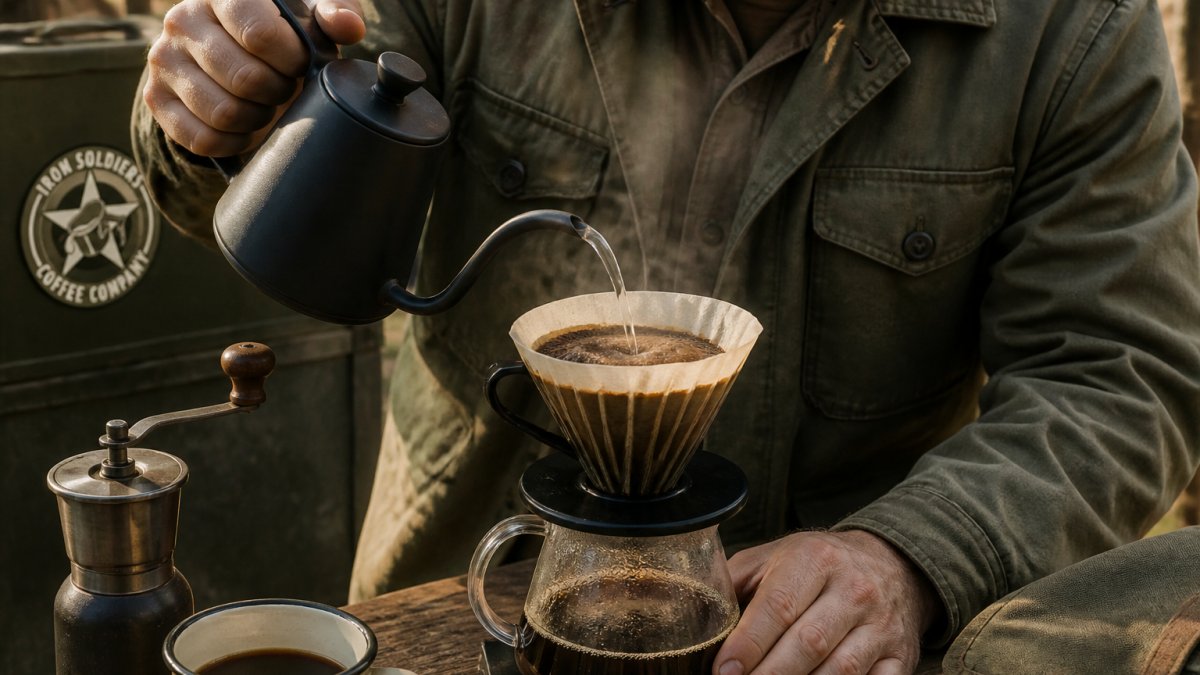
Total time: 4 to 5 minutes Difficulty: Beginner
What you'll need:
- Freshly ground coffee, medium grind
- Gooseneck kettle, water at 195 to 205 F
- Pour-over dripper and filter
- Scale
- Timer
Step 1: Rinse the filter [Time: 30 seconds] Pour hot water through the empty filter. This removes paper taste and warms the dripper.
Step 2: Add your dose [Time: 15 seconds] Add your coffee and level the bed. A flat bed saturates evenly.
Step 3: Start the clock and pour the bloom [Time: 10 seconds] Pour from the center out in a slow circle. Use about twice the coffee weight in water.
Single Origin Favorites Sample Pack →
Step 4: Wait for the bloom [Time: 30 to 45 seconds] Let the gas escape. Watch the crust rise and settle.
Step 5: Break the crust and pour the main pour [Time: 2 to 3 minutes] Stir gently, then pour in stages to your total weight.
Expected result: A flat, even coffee bed and a clean, sweet cup.
Key Takeaway
The bloom is the only part of the brew where you pour, then stop. That pause is the whole point. It is your saturation window.
Why Is My Coffee Not Blooming? Troubleshooting Weak or Uneven Blooms
Why is my coffee not blooming? The most common cause is stale coffee. Once the gas is gone, there is nothing left to release. But a weak bloom is not always a dead end.
Run this diagnostic in order. Fix the first thing that fails before moving on.
1. Check the roast date. If the bag is more than four weeks past roast, the bloom will be faint no matter what you do. That is not a technique problem. It is a freshness problem.
2. Check water temperature. Below 195 F, carbon dioxide releases slowly and the dome stays small. Between 195 and 205 F is the working range. If your kettle has been sitting, reheat it.
3. Check the pour. A fast center pour drives water through one channel and leaves dry pockets around the rim.
4. Check the grind. Too coarse and water runs through before it can wet the grounds. Too fine and the bed clogs, trapping gas under a sealed surface.
5. Check for channeling. If the bloom rises unevenly, with one side domed and the other flat, water is finding a path of least resistance. This usually traces back to an uneven bed before the pour.
Now, what does the bloom tell you about the cup ahead?
- A vigorous, tall bloom on a fresh bag signals plenty of trapped gas. Expect a brighter, more aromatic cup once that gas clears the way.
- A flat, fast bloom on a fresh bag usually means the water was too cool or the grind too coarse. The cup will likely taste weak or sour.
- An unusually long bloom that will not settle can mean the grind is too fine and the bed is holding water. Expect a slower drawdown and a heavier body.
- A bloom that collapses instantly points to stale coffee. The cup will taste flat and papery no matter how you pour.
Method-specific fixes:
- Pour-over: Slow the pour and use a gooseneck kettle for control. If the bed channels, stir gently once during the bloom.
- French press: Add all the water at once, stir, and wait 30 seconds. The full immersion makes channeling less likely, but a weak bloom still means stale beans.
- Aeropress: Bloom 30 seconds, stir, then press. If the bloom is weak, check that your water is hot enough before you blame the grind.
- Drip machine: Pre-wet the grounds manually if the machine allows it. Most automatic machines do not control bloom timing, so a quick manual pre-wet is the workaround.
Pro Tip
A weak bloom on a fresh bag often means your kettle cooled too far. Reheat and try again before you blame the beans.
Key Takeaway
The bloom is a diagnostic, not a decoration. A strong dome tells you the coffee is fresh and the water is hot. A weak one tells you which variable to fix next.
Blooming Across Brew Methods and Equipment
Blooming is not just for pour-over. Every brew method that starts with a wetting phase can use one.
Here is how the bloom shifts across gear:
- Pour-over: Full bloom, 30 to 45 seconds, then staged pours.
- French press: Add all water, stir, then wait 30 seconds before the full steep.
- Aeropress: Bloom 30 seconds, stir, then press.
- Drip machine: Hard to control, but a quick pre-wet helps if the machine allows it.
- Espresso: No bloom, but puck prep and pre-infusion play the same role.
The principle is constant. You are wetting the grounds and letting gas escape before the real extraction begins.
Equipment changes the timing, not the logic. A gooseneck kettle gives you control. A basic kettle still works if you pour slowly.
We keep a range of fresh single origins and blends ready to brew. Our Guatemala and Costa Rica roasts both bloom hard when fresh, which tells you the gas is still there.


Conclusion: Make the Bloom Your Daily Briefing
The bloom rewards patience. Pour, wait, then brew, and your cup gets cleaner and sweeter.
A weak bloom is information, not failure. It tells you about freshness, grind, and water temperature all at once.
At Iron Soldiers Coffee Company, every bag ships fresh, and $1 from each bag goes to a volunteer-only nonprofit. Our beans are roasted to bloom, and our Single Origin Favorites Sample Pack lets you test the method across six origins.

National Coffee Association brewing guidance
Shop All Coffee and start your next brew with a proper bloom.
Frequently Asked Questions
How much water should you use for a coffee bloom?
Use roughly twice the coffee's weight in water. For a 20-gram dose, pour about 40 grams of hot water, enough to wet every ground without flooding the bed. This coffee bloom ratio keeps the bed saturated so carbon dioxide can escape evenly. If the slurry still looks dry in spots after your pour, add a small splash more and give the dripper a gentle swirl.
How long should you bloom coffee?
Most pour-over recipes call for a 30-second bloom, with 30 to 45 seconds as the practical window. Freshly roasted coffee releases the most gas in the first half minute, so waiting lets the bed settle before your main pour. Older beans may finish degassing in 20 seconds. Judge by the bed, not the clock alone: when bubbling slows and the surface stops swelling, the bloom is done.
Does blooming coffee improve extraction?
Yes. When carbon dioxide escapes during the bloom, hot water can reach the coffee grounds instead of being pushed away by gas. That contact is what pulls out flavor compounds, so a proper bloom supports even saturation and a more consistent extraction yield. Skip it and you often get dry pockets, a sour or hollow taste, and weaker brew strength from the same dose.
What should you do if your coffee does not bloom?
A flat, quiet bed usually means the beans have already degassed. Check the roast date on the bag; coffee past three to four weeks post-roast releases far less gas. If your beans are fresh and still no bloom appears, your grind may be too coarse or your water too cool. Tighten the grind slightly, use water just off a boil, and try again.
A great cup starts with fresh beans and a patient pour. Iron Soldiers Coffee Company roasts to order, supports veterans and their families through every bag sold, and gives you the freshness that makes a bloom worth watching. Get started with Iron Soldiers Coffee Company and taste what a real bloom delivers.