Best Manual Coffee Grinders for Consistency
Table of Contents
- The Field Manual: Why Manual Coffee Grinders Win on Consistency
- Coffee Grinder Grind Consistency: The Specs That Actually Matter
- Choosing a Hand Grinder for Pour-Over
- Selecting a Manual Espresso Grinder
- How to Clean a Manual Coffee Grinder
- Common Mistakes That Sabotage Grind Consistency
- Conclusion: Your Daily Grind, Dialed In
- Frequently Asked Questions
Last Updated: October 8, 2026
The Field Manual: Why Manual Coffee Grinders Win on Consistency
Ask any field cook worth their salt and they will tell you the same thing: the gear matters less than the discipline behind it. That principle holds for the best manual coffee grinders for consistency, where a hand-cranked mill with a stable axle will out-perform a whirring electric blade every time. At Iron Soldiers Coffee Company, we have brewed enough pots in enough conditions to know that uniform particle size is the difference between a clean cup and a muddy one.
A manual grinder is a handheld mill that crushes roasted beans between two burrs, letting you control the particle size by hand. The key advantage is control. You feel the resistance, you hear the cut, and you adjust on the spot.
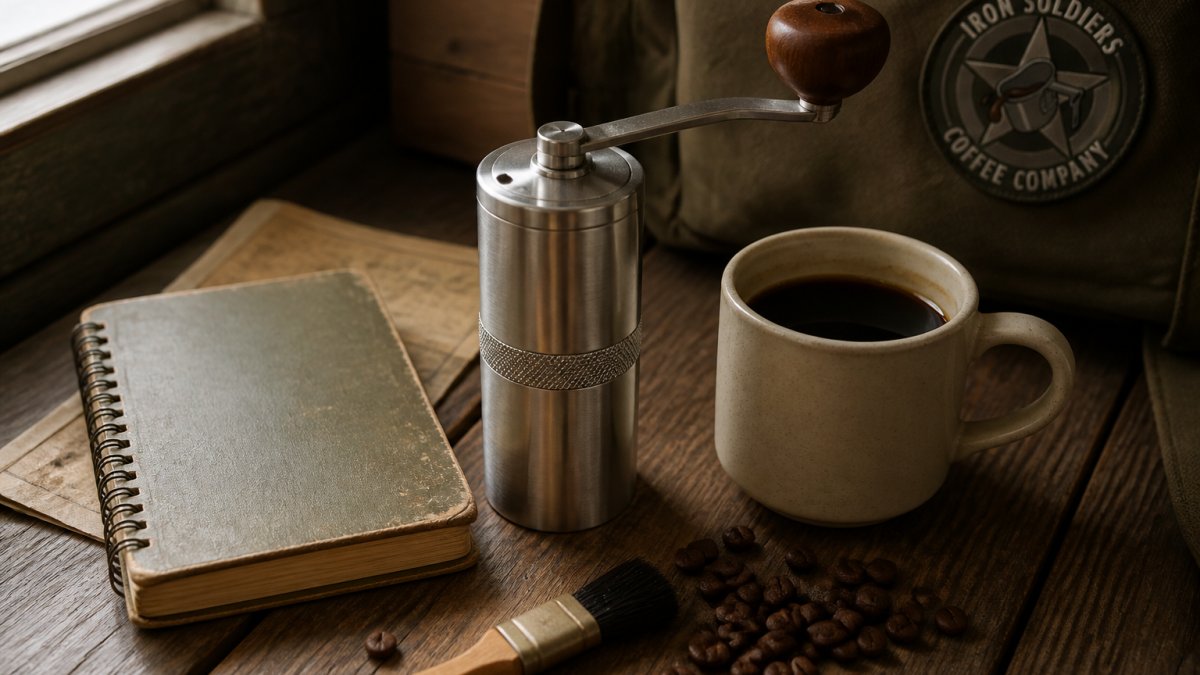
Burr Geometry and the Uniform Particle
Burr geometry determines how evenly beans fracture. Conical burrs feed beans downward and shear them in a spiral; flat burrs grind between two parallel plates. Conical sets suit hand grinding because they need less torque at low RPM.
The uniform particle is the goal. When every fragment is the same size, water extracts at the same rate across the bed. When sizes vary, fines over-extract and boulders under-extract in the same brew. One cup, two failures.
Coffee Grinder Grind Consistency: The Specs That Actually Matter
Three specifications decide whether a hand mill holds its setting: burr material, axle stability, and the adjustment mechanism. Everything else, from the handle shape to the wood finish, is comfort.
Grind consistency is the measure of how uniform the particles are after milling. It is the single variable that most affects extraction evenness.
Burr Material, Axle Stability, and Adjustment Mechanism
- Burr material: Hardened steel holds an edge far longer than ceramic-coated or softer alloys. Steel burrs also cut rather than crush, which reduces fines.
- Axle stability: A wobbling shaft throws the burr gap out of true. Look for dual bearings or a machined collar that locks the shaft in line.
- Adjustment mechanism: Stepped adjusters click into fixed positions and repeat well. Stepless adjusters offer finer control but demand more attention to return to a setting.
Pro Tip
Check axle play before you trust a grinder. Grip the handle and try to rock it side to side with the burrs closed. Any perceptible wobble will show up as inconsistent grind under load, no matter how good the burrs are.
| Spec | Why It Matters | What to Look For |
|---|---|---|
| Burr material | Holds edge, cuts instead of crushing | Hardened steel |
| Axle stability | Keeps burr gap true under load | Dual bearings or locking collar |
| Adjustment type | Repeatability of settings | Stepped clicks or fine thread |
| Burr geometry | Particle shape and flow | Conical for hand grinding |
Choosing a Hand Grinder for Pour-Over
A hand grinder for pour-over needs a medium grind with very few fines, because a paper filter punishes inconsistency. Fines clog the bed, slow the drawdown, and stall the brew.
Start with a burr set that produces a narrow particle spread at medium settings. Then confirm the adjuster can hold that setting through a full dose. Pour-over rewards repeatability more than range.
If you brew pour-over daily, treat the grinder as your primary instrument. Our own grind selection guides walk through matching grind size to brew method, and the Specialty Coffee Association's brewing standards set the extraction targets most roasters build around.
Selecting a Manual Espresso Grinder
Espresso demands the finest, most tightly controlled grind of any method. A manual espresso grinder must hold a micro-adjustment under heavy resistance, because a small shift in particle size changes the shot.
Stepless adjustment wins here. Espresso dialing lives between clicks, and a stepped adjuster often jumps past the sweet spot. Look for a fine-thread adjuster with a lock, plus burrs that stay sharp at tight gaps.
Expect a workout. Espresso grinding by hand takes real force, so a stable body and a long handle matter. If the body flexes, the burr gap opens mid-grind and the shot runs fast.
How to Clean a Manual Coffee Grinder
Learning how to clean a manual coffee grinder is the maintenance task that protects consistency between deep cleans. Oils and fines build up on the burrs, and that residue changes how beans fracture.
Disassemble only as far as the maker allows. Brush the burrs, clear the chute, and wipe the threads. Never wash steel burrs in water unless the maker says they are removable and rust-treated.
Daily Brush-Down and Deep Clean Cadence
- Daily: Brush loose grounds from the burrs and chute after the last grind.
- Weekly: Disassemble, brush every surface, and clear packed fines from the adjustment threads.
- Monthly: Do a full teardown, inspect the burrs for wear, and check the axle for play.
Watch Out
Grinding flavored beans leaves oils that cling to the burrs and carry into your next batch. If you switch between flavored and single-origin beans, brush down after every flavored dose or the flavor will follow you.
Common Mistakes That Sabotage Grind Consistency
Most consistency problems trace back to technique, not equipment. The grinder is usually fine; the operator is rushing.
- Adjusting while the burrs are loaded. Change the setting with an empty chamber, or the burr gap shifts unevenly.
- Grinding too fast. Speed heats the burrs and produces more fines. Steady, even turns beat a sprint.
- Skipping the brush-down. Built-up residue changes the burr gap over time.
- Ignoring axle wear. A loose shaft ruins an otherwise good mill.
- Storing beans in the hopper. Beans left in the grinder go stale and grind differently.
A common mistake is chasing a new grinder when a worn burr set or a loose axle is the real culprit. Inspect before you replace.
Conclusion: Your Daily Grind, Dialed In
Consistency is a discipline, not a purchase. Pick a mill with steel burrs, a stable axle, and an adjuster you trust, then keep it clean and keep your technique steady. That is the whole field manual.
When you are ready to put that discipline to work, start with fresh beans. Iron Soldiers Coffee Company roasts high-quality blends, single origins, flavored coffees, and mushroom coffee, and one dollar from every bag goes to a volunteer-only nonprofit supporting veterans and their families. Explore our Coffee Bootcamp and grind selection guides, then shop all coffee and dial in your daily grind.
Frequently Asked Questions
What makes a manual coffee grinder consistent?
Consistency comes down to three things: burr type, axle stability, and adjustment precision. Conical or flat burrs crush beans uniformly instead of chopping them, so particle size stays even. A stable axle keeps the burr centered while you crank, and a fine-threaded adjustment ring lets you lock in a repeatable setting. Blade grinders cannot match this because they randomly slice beans. Look for hardened steel burrs and tight tolerances in the axle assembly.
Can a manual espresso grinder grind consistently for espresso?
Yes, but not every hand grinder can. Espresso demands very fine, uniform particles, so you need a manual espresso grinder with stepless or micro-step adjustment and burrs designed for fine grinding. Stepped grinders with wide gaps will jump between settings and throw off your shot. Check that the manufacturer rates the grinder specifically for espresso, and expect to spend more time dialing in than you would for pour-over.
How often should I clean a manual coffee grinder?
Brush out the burr chamber and catch cup after every few uses to prevent stale oils from building up. Do a deeper clean, disassembling the burrs and brushing with a stiff brush, about once a month for daily use. If you switch between flavored and unflavored beans, clean between batches to avoid ghost flavors. Never wash burrs with water; moisture causes rust and dulls the cutting edges.
Is a more expensive hand grinder always more consistent?
No. Price often reflects burr quality, materials, and build precision, but a well-made mid-range grinder with stable burrs can outperform a flashy expensive one with poor alignment. Focus on burr material, axle play, and adjustment mechanism rather than brand name. Read user reports about grind consistency and check whether replacement burrs are available. A grinder you clean and maintain properly will stay consistent longer than a neglected premium model.
Related post

08
Oct