Best Dark Roast Coffee for French Press
Table of Contents
- Why Dark Roast Dominates the French Press
- French Press Grind Size: The Foundation of Your Brew
- French Press Coffee Ratio: Getting the Strength Right
- French Press Steep Time: Timing Your Perfect Cup
- Best Ground Coffee for French Press: Our Battle-Tested Selection
- Avoiding Bitterness and Muddy Flavor in Dark Roast French Press
- Whole Beans vs. Pre-Ground: Which Wins the Campaign
- Frequently Asked Questions
Last Updated: October 20, 2026
Why Dark Roast Dominates the French Press
Finding the best dark roast coffee for french press isn't just a preference, it's a strategic choice. The bold, smoky character of dark roast pairs exceptionally well with immersion brewing. When you steep grounds in hot water for several minutes, the full-bodied richness of dark roast shines through in a way lighter roasts cannot match.
At Iron Soldiers Coffee Company, we've found dark roast dominates the French press because it masks the bitterness that can emerge from longer steep times, while the method extracts the full complexity these beans offer.
The reason dark roast wins comes down to chemistry and method. French press steeping extracts oils and compounds that lighter roasts struggle to deliver evenly.
French Press Grind Size: The Foundation of Your Brew
Grind size decides whether your dark roast French press cup tastes like bittersweet cocoa or scorched mud. Every guide says grind coarse; few explain why dark roast changes the equation, and that is where most brews go wrong.
Dark roast beans have been pushed through a longer, hotter roast, leaving their cell structure more porous and brittle than a medium roast. When a blade grinder or fine burr setting shatters those beans into powder, immersion pulls harsh, ashy compounds out of the fines in under two minutes, a cup that tastes burnt even though the beans were fine.
What 'Coarse' Actually Means for Dark Roast
Aim for a texture like coarse sea salt or rough breadcrumbs, particles you can see and feel individually, not powder. On most conical burr grinders, start two to three clicks coarser than your drip setting and adjust from there.
Dark roast is more forgiving on the coarse end than lighter roasts. Because the bean is already developed, you can push the grind slightly coarser without the cup going thin. That gives you a safety margin against the bitterness that plagues fine-ground dark roast.
Dark Roast Grind Adjustment Chart
Use this as a starting point, then adjust one variable at a time:
| Symptom in the Cup | Likely Cause | Grind Adjustment | Pair With |
|---|---|---|---|
| Harsh, ashy, burnt | Grind too fine / too many fines | Go 1-2 settings coarser | Drop water temp to 195-200°F |
| Gritty sediment, muddy body | Excessive fines from blade grinder | Switch to burr grinder, coarse setting | Rinse the press and plunge slowly |
| Thin, sour, under-extracted | Grind too coarse for the steep time | Go 1 setting finer | Extend steep to 4.5 minutes |
| Bitter but weak | Over-extraction of fines, under-dosed | Coarser grind + tighten ratio to 1:13 | Verify water at 200°F |
The Grinder Is the Mission-Critical Gear
A blade grinder produces an inconsistent particle spread, boulders mixed with powder. In a French press, the powder over-extracts while the boulders under-extract, and you taste both at once. A burr grinder gives you a repeatable coarse setting, the only way to dial in dark roast consistently.
Pro Tip
Grind immediately before brewing. Dark roast releases its aromatic oils quickly after grinding, and a four-minute steep magnifies stale flavors. Sixty seconds at the grinder is the cheapest upgrade to your cup.
French Press Coffee Ratio: Getting the Strength Right
Your French press coffee ratio determines whether you get a bold, energizing cup or a weak one.
For a standard 34-ounce French press, that translates to roughly 2.3 ounces of ground coffee and 32 ounces of water for a balanced cup, or 2.7 ounces for a stronger brew. A scale gives you precision rather than guessing with tablespoons.
Dark roast beans are forgiving at higher ratios because their bold character won't disappear into the water. Lighter roasts at the same ratio often taste thin. With dark roast, you have room to experiment and dial in your preference without the over-extraction worries of a medium roast.
French Press Steep Time: Timing Your Perfect Cup
French press steep time directly impacts extraction and flavor balance. The standard is 4 minutes, but the best dark roast coffee for french press handles variation depending on grind consistency and personal taste.
Start with 4 minutes as your baseline. At the 4-minute mark, press down slowly, about 30 seconds, and pour immediately. This prevents over-extraction and keeps sediment from settling back into your brew.
If your cup tastes bitter or muddy, drop to 3.5 minutes next brew. If thin or under-extracted, increase to 4.5. Dark roast's strong character gives you flexibility here. The key is consistency: measure your time, note what worked, and repeat.
Best Ground Coffee for French Press: Our Battle-Tested Selection
These are the dark roast options we've tested and refined specifically for French press brewing. Each delivers the full-bodied richness and flavor complexity that makes this brewing method shine.
Sherman Tank Edition: The House Blend Arsenal
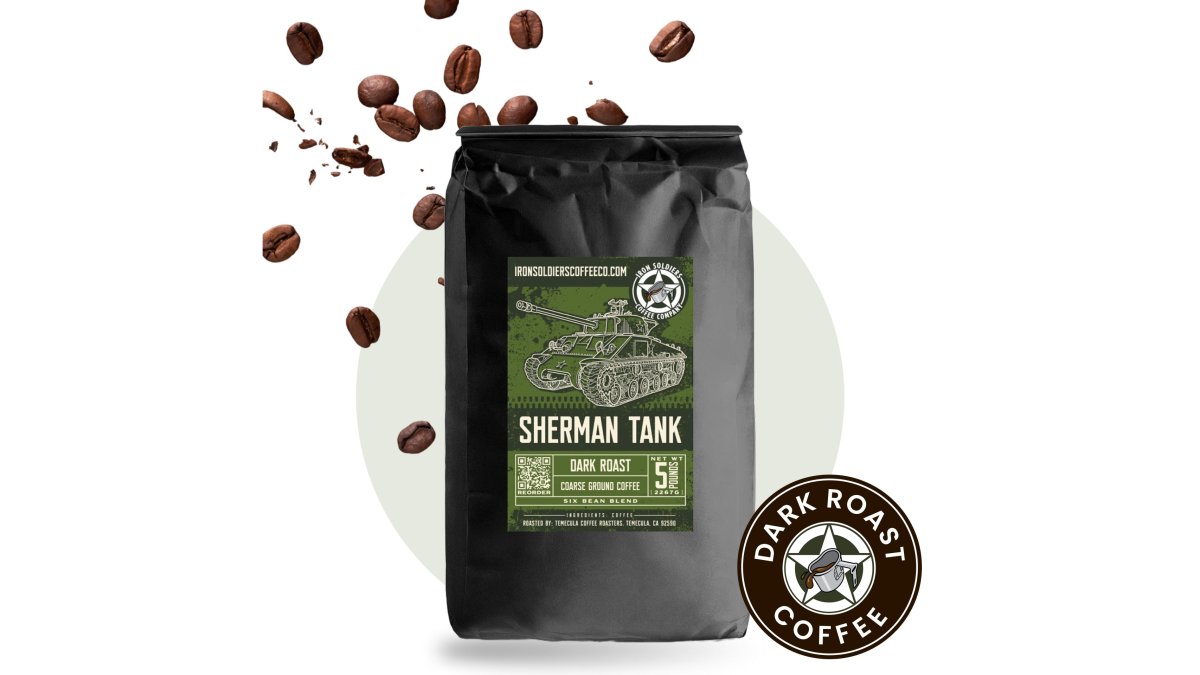
What makes this blend work for French press is its balance: bittersweet cocoa and toasted nuts up front, a touch of caramel and a satisfying finish.

The Sherman Tank Edition handles the full French press coffee ratio range well. Brew it at 1:15 for a balanced cup or tighten to 1:12 if you want maximum intensity. Either way, the blend delivers without fading.
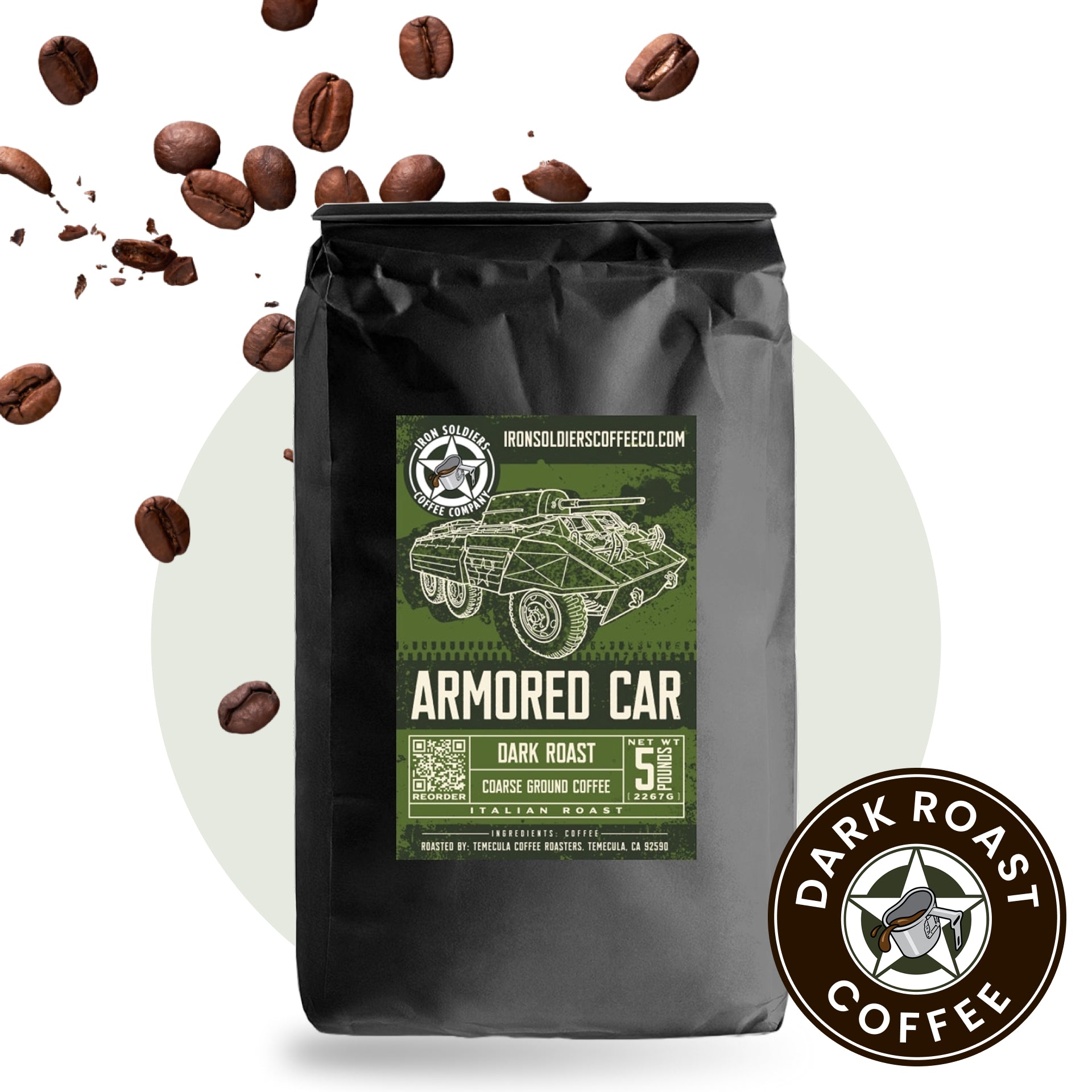
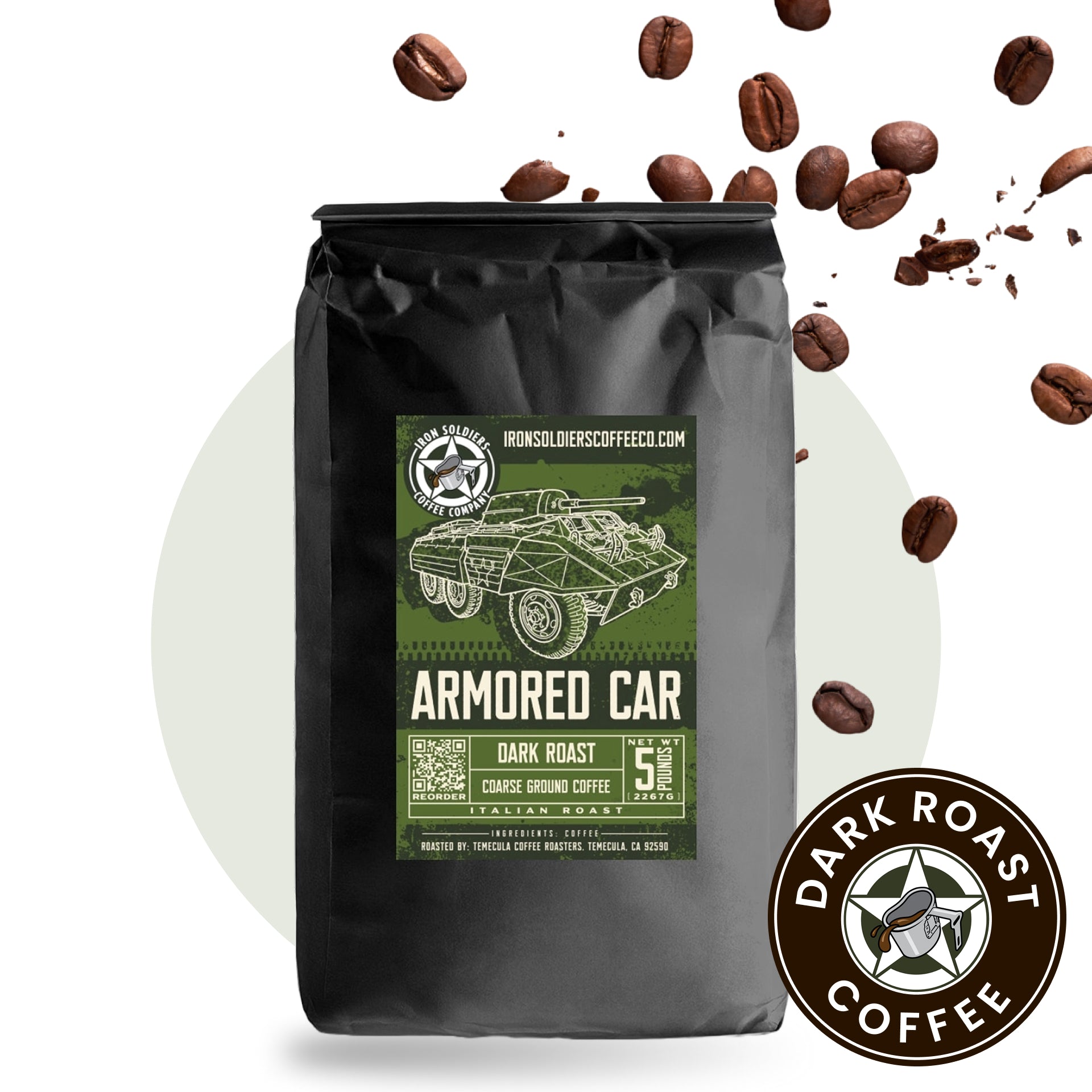
Armored Car Edition: Maximum Intensity
The Armored Car Edition is the darkest roast in our lineup, an Italian Roast that doesn't hold back, bold, smoky intensity with deep chocolate and toasted caramel undertones, specialty-grade coffee roasted to the edge of what dark roast can deliver.
The Armored Car's darker profile extracts quickly in a French press. Steep slightly shorter, 3.5 to 4 minutes, because roasting has already broken down the bean structure. This prevents over-extraction while still pulling maximum flavor.
At $19.99 for a 12oz bag, this is the choice for shift workers and professionals who need coffee that delivers serious presence. The flavor profile is commanding without becoming unpleasant, and it won't fade halfway through your morning.
Dany's D-Day Blend French Roast: Historic Strength
Dany's D-Day Blend French Roast honors the story of Dany Patrix, a young French girl whose life was forever changed by the arrival of American soldiers on D-Day.
The French Roast profile sits darker than medium-dark but slightly lighter than the Armored Car Edition, a middle ground between intensity and nuance, with the full-bodied richness dark roast is known for and a smooth finish that doesn't veer into harshness.
Brewed at a standard 1:15 ratio with a 4-minute steep, this blend shines. The historical connection behind each bag, a tribute to freedom and the enduring bond between nations, adds meaning to your daily ritual. At $19.99, it's priced identically to our other core offerings.
Mushroom Coffee - Frontline Focus Blend: Sustained Mission
For those seeking something beyond traditional dark roast, our Mushroom Coffee - Frontline Focus Blend combines specialty-grade dark roast with Lion's Mane, Cordyceps, and Reishi mushrooms, engineered for steady energy.
The dark roast base delivers the same full-bodied flavor you expect from a French press brew. The mushroom blend adds smoothness and subtle earthiness that complements rather than overwhelms. Steep time remains standard at 4 minutes; the mushrooms don't change the brewing equation.
At $21.99 for an 8oz bag, this is the premium option for professionals and shift workers who need intensity. You get the bold flavor of dark roast.
Avoiding Bitterness and Muddy Flavor in Dark Roast French Press
Bitterness in dark roast French press usually stems from one of three culprits: over-extraction from too fine a grind, excessive steep time, or water temperature too high. The fix is systematic.
First, verify your grind size. If you're seeing sediment in your cup or tasting harsh bitterness, your grind is too fine.
Second, check your steep time. Four minutes is standard, but if your cup tastes bitter, drop to 3.5 minutes on your next brew.
Third, verify your water temperature. Ideally, use water between 195 and 205 degrees Fahrenheit. If you're using boiling water straight from the kettle, you're likely extracting too aggressively.
Muddy flavor, flat, dull, without clarity, usually means under-extraction: grind too coarse, water too cool, or steep time too short.
Whole Beans vs. Pre-Ground: Which Wins the Campaign
Whole beans win for French press, but the reason is more specific than 'fresh tastes better.' Dark roast is the most porous roast profile, making it the most vulnerable to oxidation, and the French press exposes that vulnerability most clearly.
Why Dark Roast Is the Most Fragile Roast
During roasting, dark beans lose internal structure and release more oils to the surface. Those oils are aromatic and volatile. Once ground, the increased surface area accelerates oxidation and off-gassing. In a four-minute immersion, every stale compound has time to dissolve into your cup, a quick drip brew masks some of that; a French press does not.
Pre-ground dark roast begins losing its peak flavor within hours of grinding and is noticeably flat within a week or two, even in a sealed bag. Whole beans hold their character far longer because the oils stay protected inside the bean until you grind.
A Practical Freshness Timeline for Dark Roast
- Days 1-7 after roast: Peak aromatics. Expect the fullest chocolate and caramel notes.
- Days 8-21: Still excellent for French press. Slight softening of top notes.
- Days 22-35: Drinkable but flatter. Tighten your ratio slightly to compensate.
- Beyond 5 weeks: Noticeable staleness. Fine for a backup bag, not for a showcase brew.
Store beans in an airtight container away from heat, light, and moisture. Do not refrigerate, condensation accelerates staling. Buy from a roaster that prints a roast date, not just a best-by date.
When Pre-Ground Makes Sense
Pre-ground is a legitimate choice for travel, office brewing, or a backup kit when you cannot grind on site. Buy the smallest bag you'll finish within two weeks, choose a coarse grind labeled for French press, and store it sealed. You trade some aroma for convenience, a fair trade on the road, a poor one at home.
Key Takeaway
For dark roast French press, whole beans ground coarse immediately before brewing are the single biggest quality lever after grind size itself. A burr grinder plus a bag with a recent roast date beats any pre-ground shortcut.
Frequently Asked Questions
What is the best dark roast coffee for French press brewing?
Dark roast coffee excels in a French press because its bold, full-bodied character stands up to the immersion brewing method. Look for beans with low acidity and rich flavor notes like chocolate, caramel, and toasted nuts. The Sherman Tank Edition and Armored Car Edition are specialty-grade dark roasts engineered for French press, delivering the deep, smoky intensity this brewing method demands without tasting thin or over-extracted.
What French press grind size should I use for dark roast coffee?
Use a coarse grind for dark roast in a French press, similar to breadcrumbs or sea salt. This prevents over-extraction and bitter flavors that occur with finer grounds. Coarse grind allows water to flow through the coffee bed evenly during the 4-minute steep, extracting the rich, smooth flavors dark roast offers without pulling out harsh, astringent compounds that create muddy taste.
How long should dark roast coffee steep in a French press?
Steep dark roast coffee for 4 minutes in a French press. Start by pouring hot water (195-205°F) over your coarse grounds, let them bloom for 30 seconds, then fill to the top. At 4 minutes, press the plunger slowly. This timing extracts the full-bodied richness and bold flavors dark roast delivers without over-steeping, which can introduce bitterness or a muddy flavor profile.
What coffee-to-water ratio works best for dark roast French press?
Use a 1:15 coffee-to-water ratio as your baseline: 1 gram of coffee to 15 grams of water. For a standard 34-ounce French press, that's about 2.3 ounces (65 grams) of dark roast coffee. Adjust to taste, use more coffee for a stronger brew if you're a shift worker or heavy drinker, or less if you prefer lighter body. Dark roast's natural boldness means you can dial in your preferred strength without losing flavor clarity.
Should I use whole beans or pre-ground dark roast for French press?
Whole beans deliver superior freshness and flavor for French press. Grind them just before brewing to preserve the complex notes dark roast offers. Pre-ground coffee loses volatile compounds within days of grinding, resulting in flat, stale flavor. If you purchase whole-bean dark roast and grind fresh each morning, you'll taste the difference, richer body, cleaner finish, and the chocolate and caramel notes that make dark roast worth the investment.
Related post
20
Oct
17
Oct