Why Coffee Is Significant in American Military History
Table of Contents
- The Role of Caffeine in Combat Readiness
- History of Coffee Rations in the Military
- Logistics of Coffee Distribution in Wartime
- Coffee as a Morale Booster for Soldiers
- The American Red Cross and Military Support
- Technological Advancements in Field Brewing
- How to Verify Charity Coffee Donations
- Frequently Asked Questions
Last Updated: September 30, 2026
The Role of Caffeine in Combat Readiness
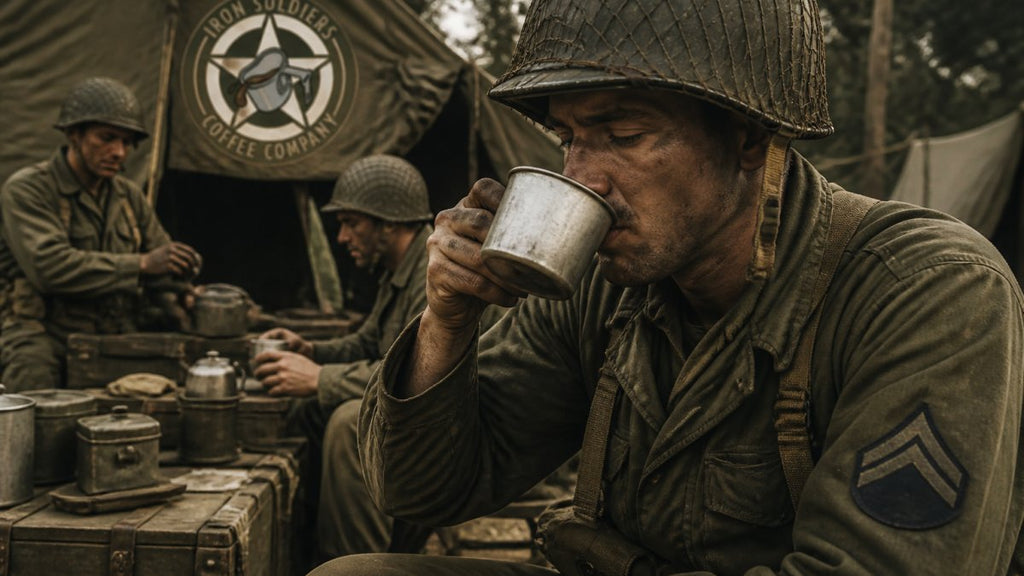
Why coffee is significant in American military history comes down to one thing: it served as a tactical tool for alertness, endurance, and sustained operational tempo on the front lines. At Iron Soldiers Coffee Company, we study this legacy closely, because the same need for a reliable stimulant that kept a soldier sharp on watch still drives the modern service member and shift worker.
The military value of coffee never rested on flavor alone. It rested on function. A caffeinated soldier on night watch stayed awake, stayed alert, and stayed ready. Armies that could deliver that stimulant to the frontline held a quiet advantage over those that could not.
That advantage came down to three practical needs:
- Alertness during long watches and early patrols
- Tactical endurance through extended operations
- Sustenance when hot meals were impossible
A common mistake is treating coffee as a luxury in the field. In practice, it was a piece of gear.
History of Coffee Rations in the Military
The history of coffee rations in the military traces back to the 19th century, when coffee became a standard provision issued to troops. By the Civil War era, coffee was a staple of field rations, and soldiers brewed it in tin cups over open fires whenever the supply chain allowed. The ration of that era was brutally simple: hardtack, salt pork, and coffee. Soldiers called the coffee "canteen coffee" or, more often, just "java", a term that stuck in the ranks long after the war.
The etymology of "java" is worth pausing on, because most guides skip it. The word entered military slang through the island of Java, long a major coffee-growing source in the global trade. Sailors and soldiers picked it up as shorthand, and it survived every subsequent ration change. The same is true of "cup of Joe", a phrase popularized in the early 20th century and tied to the Navy's decision to adopt coffee as a standard ration. Language is a record of supply, and the slang proves how deeply coffee embedded itself in service life.
From there, the ration evolved in clear steps:
- Civil War era (1861-1865): Whole green and roasted beans issued alongside hardtack; soldiers roasted and ground them in the field.
- Late 19th century: Pre-roasted, pre-ground coffee in sealed tins became standard, cutting prep time.
- World War I: The Army adopted soluble (instant) coffee experiments; the ration tin and the canteen cup became the standard kit.
- World War II: Instant coffee was issued at scale in the field ration and in the K-ration, D-ration, and later C-ration lineups. A soldier could make a cup with cold water if he had to.
- Postwar to Vietnam: The C-ration accessory pack included a small instant coffee packet, sugar, and a creamer substitute, the direct ancestor of the modern MRE coffee packet.
- Modern era: The MRE (Meal, Ready-to-Eat) carries a coffee, cocoa, or beverage base packet, plus a flameless ration heater that lets a service member brew without a fire.
What most guides miss is that ration design follows logistics, not taste. If a provision is heavy, perishable, or slow to prepare, it gets cut. Coffee survived every cut because it earned its place, and each step in the chain from hardtack to MRE reduced the time a soldier spent preparing a cup while increasing the time spent on the mission. The transition from hardtack-and-coffee to modern MREs is the clearest single arc in the whole story: convenience became a requirement, not a comfort.

Key Takeaway
Follow the coffee packet through the ration line and you follow the entire logic of military logistics: lighter, faster, more reliable, and always ready when the line is long and the watch is cold.
Logistics of Coffee Distribution in Wartime
Moving coffee to the frontline was a supply chain problem before it was a morale problem. Beans are bulky, moisture spoils them, and a field kitchen cannot run on a broken line. Quartermasters solved this by shipping roasted and ground coffee in sealed tins, then later by adopting instant coffee that weighed less and lasted longer.
The wartime economy rewarded anything that reduced weight and waste. A canteen of instant coffee could be carried where a crate of beans could not. That single change reshaped how commanders thought about provisions.
Pro Tip
The real test for any field provision is weight versus output. Instant coffee won its place because it delivered a full cup with almost no cargo penalty. That same logic still governs how expeditionary units pack today.
Coffee as a Morale Booster for Soldiers
Why coffee is significant in American military history as a morale booster for soldiers is one of the most documented themes in the field. A hot cup in a cold trench did more than warm a soldier's hands. It created a moment of normalcy inside a deployment defined by hardship.
That moment mattered. Camaraderie forms around shared rituals, and the coffee break became one of the few rituals a service member could control. It marked the end of a watch, the start of a patrol, or a brief pause before the next push.
Instant Coffee - Field Ration Edition →
The psychological impact of the coffee break in service should not be underestimated. A stimulant that also signals rest gives a tired mind something to look forward to. That is why coffee culture in deployment environments ran deeper than caffeine alone.
The American Red Cross and Military Support
The American Red Cross and military support organizations turned coffee into a symbol of home. During both world wars, relief workers served coffee to service members at canteens and mobile stations, often far from any formal mess hall.
Those stations did more than pour drinks. They gave troops a place to sit, talk, and feel remembered. For a young soldier overseas, a cup handed over by a volunteer carried cultural significance that no ration tin could match.
That tradition of civilian support for the troops continues today. Many mission-driven coffee brands now direct a portion of every sale to veteran-focused nonprofits, echoing the same impulse that put Red Cross canteens near the front.
Technological Advancements in Field Brewing
Field brewing advanced from open-fire tin cups to compact, reliable methods built for speed. The canteen cup gave way to instant coffee, then to portable brewing kits designed for expeditionary use. Each generation of gear chased the same goal: a hot cup with minimal time, fuel, and cleanup.
But the deeper story, the one most guides skip, is how coffee availability shaped specific turning points.
- Cold Harbor and the Overland Campaign (1864): Union soldiers brewed coffee in the trenches under fire. The ritual of a hot cup during a siege-like stalemate became a marker of unit cohesion and a small anchor of normalcy in a campaign defined by exhaustion.
- The Meuse-Argonne (1918): In the final push of the First World War, hot coffee served at forward stations helped keep tired troops moving through days of sustained attack. Relief workers and mess personnel treated the coffee line as a combat multiplier, not a comfort.
- The Battle of the Bulge (1944-1945): In the coldest fighting of the European campaign, a hot cup was both a physiological and psychological lifeline. Field kitchens and rear-echelon stations pushed coffee forward whenever the line allowed, and the cup became a signal that the supply chain was still holding.
- Long-range patrols and modern deployments: Today's service member carries an instant coffee packet in the MRE accessory pack and a flameless ration heater. The mechanism is the same as it was in 1864, hot water, a moment of pause, a return to the mission, just compressed into a pouch.
Pro Tip
When you study field brewing, study the constraint, not the gadget. Every advance, the tin, the soluble packet, the flameless heater, solved the same problem: how to get a hot cup to a tired soldier with the least possible weight, fuel, and time.
How to Verify Charity Coffee Donations
Verifying charity coffee donations comes down to one question: can the brand show you where the money actually goes? A patriotic label is not proof. Documentation is. Before you trust any "support the troops" claim, run the brand through a short checklist.
- Confirm the brand names the specific nonprofit it supports
- Check whether that nonprofit is a registered 501(c)(3)
- Look up the nonprofit's tax filings on the IRS Tax Exempt Organization Search
- Read the brand's own page explaining the donation terms
- Look for a stated amount per unit sold, not a vague promise
- Search for third-party coverage or reviews that confirm the giving
| Verification Step | What to Check | Why It Matters |
|---|---|---|
| Nonprofit named | Specific organization, not a slogan | Confirms a real recipient exists |
| Tax status | 501(c)(3) listing on IRS records | Confirms legitimate charitable status |
| Donation terms | Stated amount per unit sold | Confirms the claim is measurable |
| Public disclosure | Brand page or filings | Confirms the brand stands behind the claim |
Frequently Asked Questions
What role did coffee play in the American Civil War?
Coffee was a daily staple for Union and Confederate soldiers, often traded across enemy lines when supplies ran low. It provided warmth, energy, and a brief sense of normalcy amid hardship. Soldiers brewed it in makeshift pots over campfires, and the ritual became a small comfort in brutal conditions, laying the groundwork for coffee's lasting place in military culture.
Why is coffee often referred to as 'Joe' in the military?
The nickname 'Joe' likely stems from Josephus Daniels, Secretary of the Navy during World War I, who banned alcohol on ships, making coffee the strongest drink available. Sailors began calling their coffee 'a cup of Joe' as a nod to his order. The term spread across the armed forces and remains a common slang for coffee today.
How can I verify that a coffee brand's charitable donations actually reach veterans?
Look for brands that publicly name their nonprofit partners and provide donation reports. Check the nonprofit's website for donor lists or impact statements. Reputable brands often share receipts or partner testimonials. You can also search the IRS Tax Exempt Organization Search to confirm a nonprofit's status. If a brand is vague about where money goes, ask directly or choose one with transparent giving.
What coffee does the U.S. military use today?
Modern MREs include instant coffee packets, often with creamer and sugar. In dining facilities, bulk coffee is brewed from commercial roasters. Some units deploy with specialty coffee kits for morale. The military prioritizes shelf-stable, easy-to-prepare options that deliver caffeine reliably, whether in a foxhole or a forward operating base.
Related post
21
Oct
20
Oct