Is High Caffeine Coffee Worth the Price?
Table of Contents
- The Value Equation: Price vs. Potency vs. Quality
- Understanding Caffeine Content in Coffee Beans
- How to Brew Strong Coffee for Maximum Impact
- Best High Caffeine Coffee Brands for Serious Drinkers
- Health Considerations and Daily Caffeine Limits
- Calculating Cost Per Cup: What You're Really Paying
- Tolerance, Habituation, and Long-Term Value
- The Verdict: Is Premium High Caffeine Coffee Worth It?
The Value Equation: Price vs. Potency vs. Quality
When standing in the coffee aisle or scrolling through specialty roasters online, a critical question emerges: is high caffeine coffee worth the premium price? At Iron Soldiers Coffee Company, we've fielded this from serious drinkers demanding both performance and integrity. The answer hinges on three factors: price, actual caffeine delivered, and whether quality justifies the cost.
Most commodity coffee delivers 95-200 milligrams of caffeine per 8-ounce cup. Specialty-grade high caffeine coffee often reaches 250+ milligrams depending on bean variety and roast profile. However, higher caffeine alone doesn't guarantee better value. A cheap robusta bean loaded with caffeine might deliver a jittery, unpleasant experience, while a premium arabica blend offers less raw caffeine but superior taste, smoother absorption, and better overall performance.
Premium high caffeine coffee justifies its price when the combination of potency, quality, and mission alignment delivers measurable returns. For shift workers, professionals requiring sustained alertness, and those supporting mission-driven nonprofits, the answer leans toward yes. For casual drinkers content with standard grocery-store coffee, the premium may not align with their needs.
::tip The mistake most buyers make is chasing the highest caffeine number without considering extraction efficiency. A well-brewed cup of quality beans delivers more usable caffeine than a poorly extracted cup of high-caffeine beans. Brewing method matters as much as bean selection. :::
Understanding Caffeine Content in Coffee Beans
Caffeine concentration in coffee is determined by bean genetics, growing conditions, and processing. Understanding these factors enables smarter purchasing decisions instead of guessing based on marketing claims.
Robusta vs. Arabica: The Caffeine Difference
Robusta beans contain roughly twice the caffeine of arabica beans by weight. Robusta carries 1.7-4% caffeine, while arabica ranges from 0.8-1.4%. This is why robusta dominates instant coffee and espresso markets.
However, robusta comes with trade-offs. The flavor profile tends toward bitter and earthy. Many specialty roasters avoid robusta entirely because taste suffers. For drinkers prioritizing pure caffeine delivery, robusta blends offer genuine value. Some premium roasters blend small amounts of robusta with arabica to boost caffeine while maintaining drinkability.
Arabica, the more expensive and widely respected bean, offers complexity, brightness, and smoother caffeine absorption. For those seeking high caffeine coffee that tastes exceptional, arabica-dominant blends represent the optimal choice.
Roast Profile and Caffeine Concentration
A persistent myth claims dark roasts contain less caffeine than light roasts because "caffeine burns off during roasting." This is largely false. Caffeine is remarkably heat-stable, with negligible differences between light and dark roasts of the same bean, typically less than 5%.
What changes is bean density. Dark roasts shrink slightly during extended roasting, so a scoop of dark roast weighs less than a scoop of light roast. Measured by weight, the difference disappears. Measured by volume, light roasts deliver slightly more caffeine per scoop.
The real advantage of dark roasts for high caffeine coffee seekers is flavor and mouthfeel. Dark roasts deliver bold, full-bodied profiles with reduced acidity, ideal for espresso and strong brews. Iron Soldiers Coffee Company's dark roast offerings, like the Sherman Tank Edition and Armored Car Edition, pack serious caffeine punch alongside the intense, commanding flavor profile that serious drinkers demand.

Key Takeaway
Caffeine content is determined by bean type and processing, not roast color. Dark roasts aren't lower in caffeine; they're denser and deliver more intense flavor with comparable caffeine levels.
How to Brew Strong Coffee for Maximum Impact
Brewing method determines whether you extract premium high caffeine coffee effectively. Extraction efficiency, the percentage of soluble compounds pulled from grounds, determines how much caffeine and flavor actually reach your cup.
Brewing Ratio and Extraction Efficiency
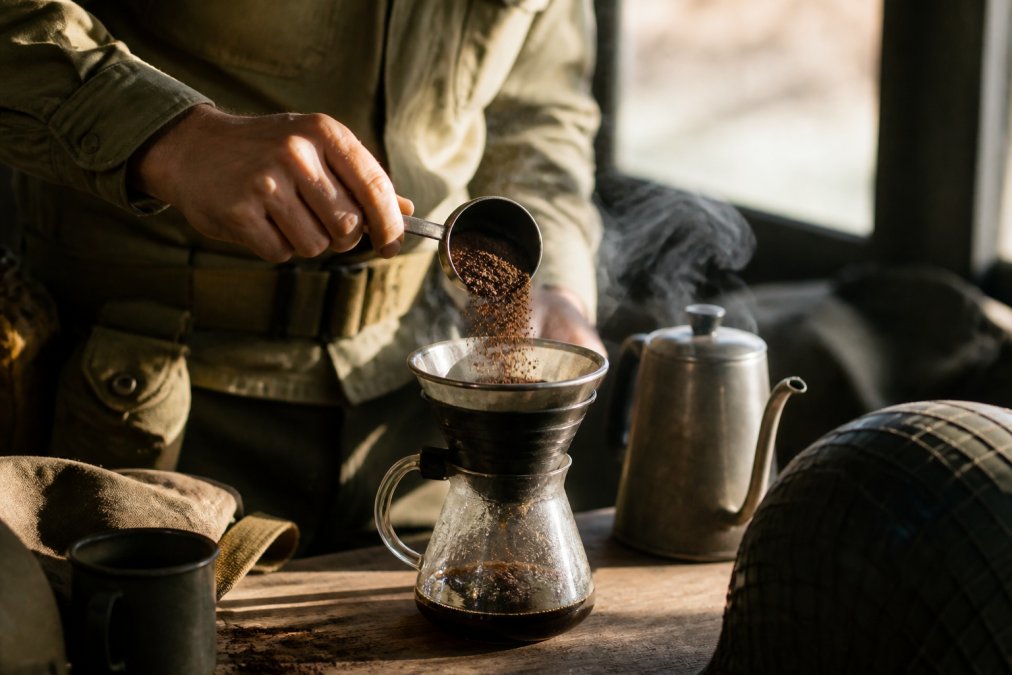
The golden standard is roughly 1:16 coffee-to-water by weight. For practical measurement, that's about 2 tablespoons of grounds per 6 ounces of water.
For high caffeine coffee, shift this ratio toward strength. A 1:14 ratio increases caffeine concentration without sacrificing drinkability. A 1:12 ratio produces a genuinely strong cup, approaching espresso intensity.
Brewing method matters significantly. French press and espresso machines extract at higher rates than drip coffee. French press typically extracts 25-30% of soluble material, while espresso pushes toward 25-35% with much less water. For maximum caffeine delivery, espresso and French press reign supreme because they use more grounds relative to water and longer contact time.
Water Temperature and Brew Strength
Water temperature between 195-205°F extracts optimal caffeine and flavor. Too cool, and extraction stalls. Too hot, and you over-extract, pulling bitter compounds that mask quality.
For high caffeine coffee, consistency matters. Use a thermometer if available. If not, let boiling water cool for 30 seconds before pouring. This simple discipline increases extraction efficiency by 10-15%.
Brew time also drives extraction. A 4-minute French press pulls more caffeine than a 2-minute pour-over. Match your brewing time to your extraction goals.
Best High Caffeine Coffee Brands for Serious Drinkers
The market offers genuine options for those serious about high caffeine coffee. We focus on options delivering measurable performance and aligned with mission-driven values.
Dark Roasts: The Intensity Factor
Dark roast coffee delivers the psychological and flavor experience of intensity. When paired with proper brewing technique, the caffeine content matches the perception.
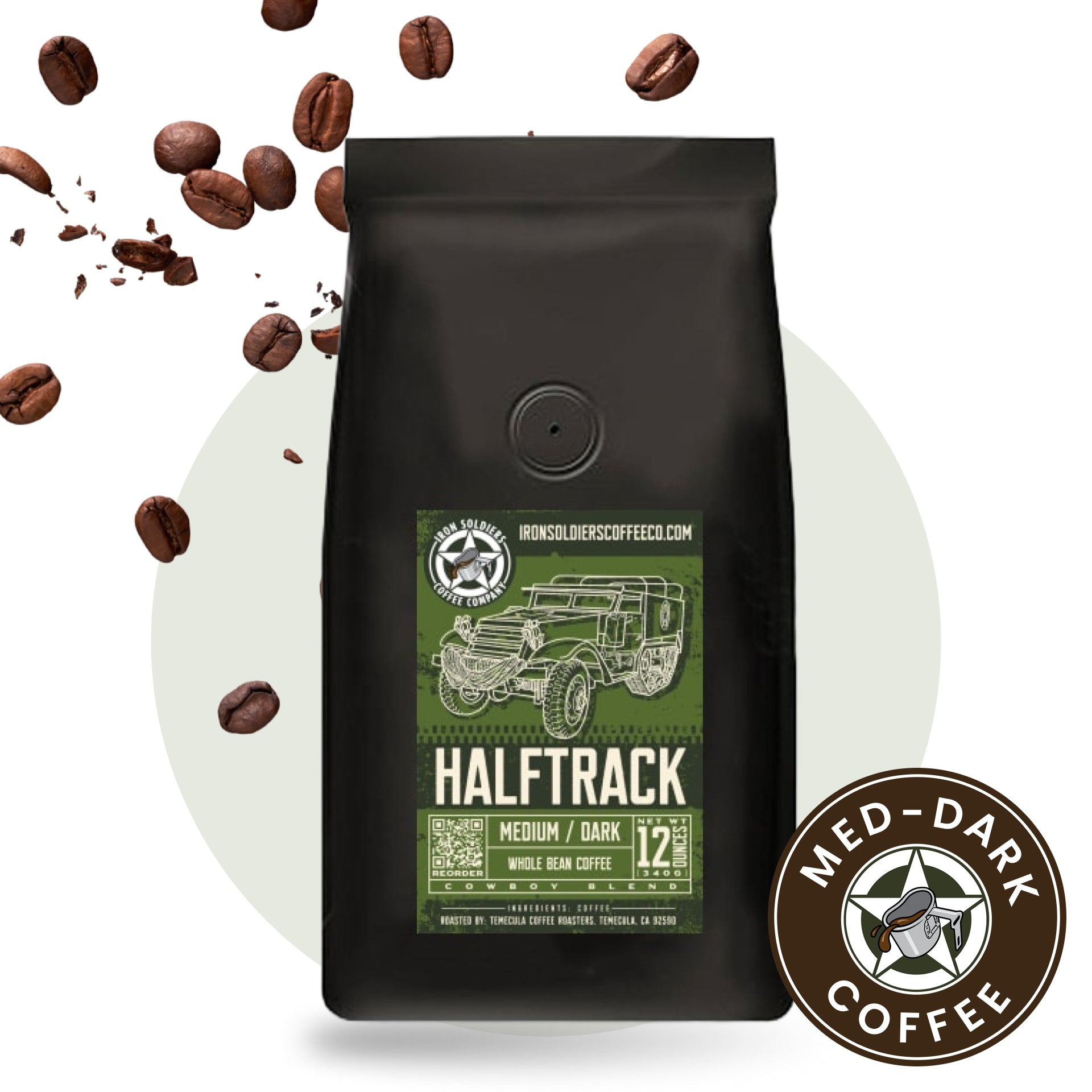
Iron Soldiers Coffee Company's Sherman Tank Edition stands as a house blend tribute to the iconic WWII tank. This dark roast combines beans from around the globe, crafted for those demanding bold intensity and complexity. The Sherman Tank Edition delivers specialty-grade quality at a price point that justifies the premium.
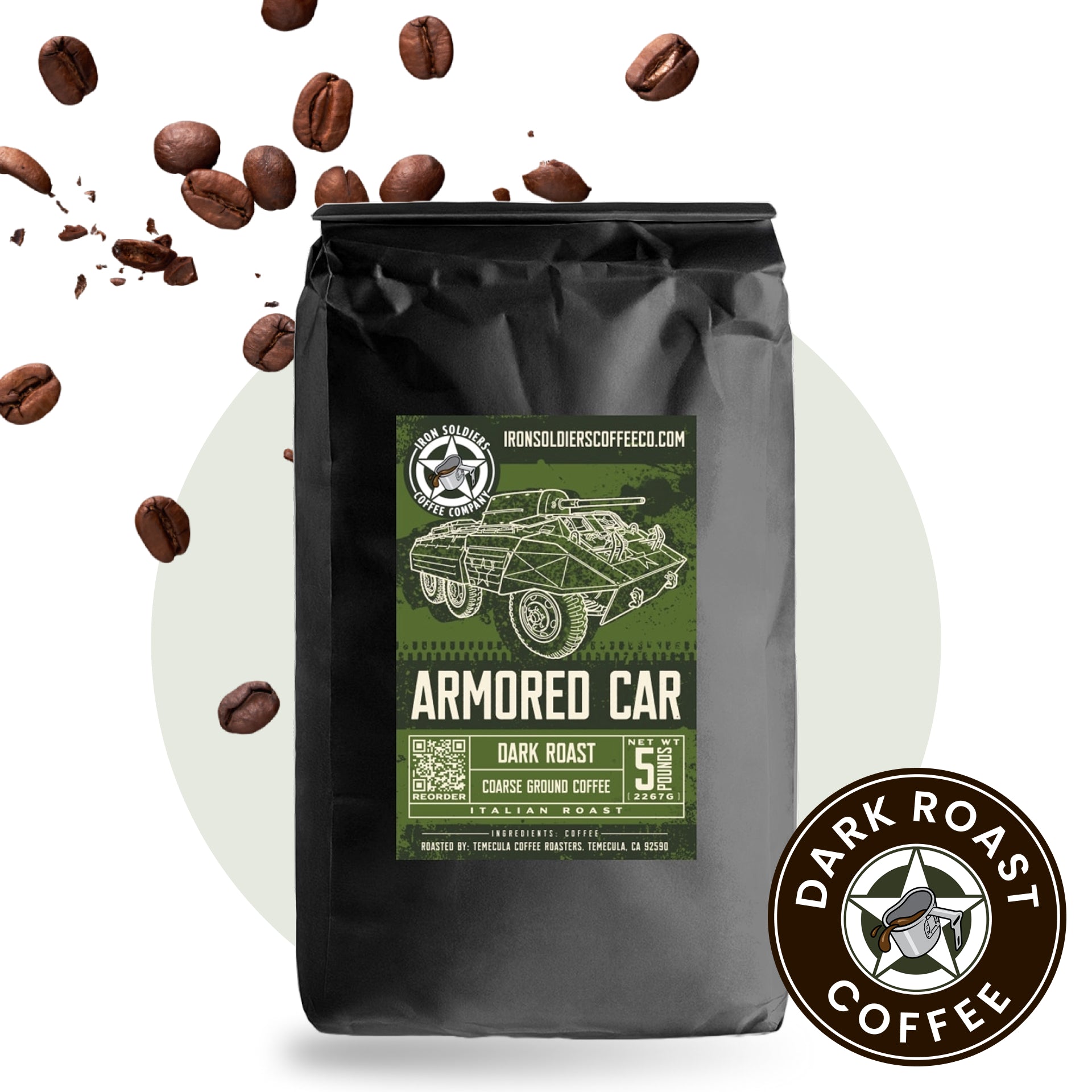
The Armored Car Edition represents the darkest roast in the Iron Soldiers lineup, an Italian roast honoring the WWII Ford Armored Car. This is coffee engineered for endurance, with deep smoky intensity and undertones of dark chocolate and toasted caramel. The Armored Car serves drinkers who've moved past "strong coffee" into serious territory.
Specialty Blends with Mission-Driven Purpose
Beyond raw caffeine and flavor, some drinkers want their coffee purchase to mean something. Iron Soldiers Coffee Company's African Espresso represents specialty-grade coffee forged to honor the Greatest Generation. This medium-dark roast blends beans from Kenya, Tanzania, and Ethiopia, delivering dynamic and resilient character. African Espresso delivers strong flavor with vibrant citrus undertones and a lingering finish that justifies the premium.

The Mushroom Coffee, Frontline Focus Blend deserves particular attention for those seeking high caffeine coffee without the jitters. Available in both medium and dark roasts, this blend combines specialty-grade coffee with Reishi mushrooms. The mushroom blend delivers smooth, sustained energy without the crash that pure caffeine alone produces. For shift workers and professionals facing long stretches of demanding focus, this represents genuine value, the mushroom compounds support cognitive clarity while the coffee provides the caffeine backbone.

Dany's D-Day Blend French Roast honors Dany Patrix, a young French girl whose life was forever changed by D-Day. This special blend carries historical weight alongside bold, smoky flavor. Every purchase supports veteran initiatives through Iron Soldiers' mission-driven model.
Best For
Professionals and shift workers requiring sustained alertness without jitters. The mushroom blend reduces adenosine receptor overstimulation while maintaining caffeine delivery.
Health Considerations and Daily Caffeine Limits
Caffeine is a stimulant, and effectiveness depends on how you wield it. The FDA recognizes 400 milligrams per day as safe intake for most healthy adults, roughly 4 cups of standard brewed coffee or 2 cups of strong high caffeine coffee.
Exceeding this threshold regularly produces diminishing returns. Jitteriness, anxiety, sleep disruption, and elevated heart rate become problems. Caffeine tolerance builds rapidly within days, requiring more caffeine for the same effect.
High caffeine consumption also triggers vasoconstriction, raising blood pressure temporarily. For those with hypertension, this matters. For healthy individuals, occasional spikes are manageable.
Caffeine sensitivity varies dramatically between individuals. Genetics play a major role. Start with standard caffeine doses and assess your body's response. If experiencing negative effects, reduce intake or shift to lower-caffeine options.
Calculating Cost Per Cup: What You're Really Paying
A typical 12-ounce bag contains roughly 40-50 grams of coffee. Using the 1:16 brewing ratio, that yields about 5-6 cups per bag. A $20 bag costs roughly $3.33 to $4.00 per cup.
Compare that to grocery-store coffee at $5-8 per pound, yielding 8-10 cups at $0.50-1.00 per cup. On raw cost per serving, specialty coffee appears expensive.
But the comparison misses the point. Specialty high caffeine coffee delivers measurable differences: higher actual caffeine content, superior flavor, better extraction efficiency, and often mission alignment. A cup of Iron Soldiers Coffee Company's dark roast delivers more sustained alertness than two cups of commodity coffee. The effective cost per unit of benefit narrows considerably.
For mission-driven drinkers, the math shifts further. Iron Soldiers donates $1 from every bag sold to a volunteer-only nonprofit supporting veterans and their families. That bag isn't just coffee, it's a contribution to something larger. If you're already spending $3-5 per cup on coffee, directing that spending toward a brand with genuine mission purpose represents value beyond the liquid in your cup.
| Cost Factor | Commodity Coffee | Specialty High Caffeine |
|---|---|---|
| Price per bag | $5-8 | $19-25 |
| Cups per bag | 8-10 | 5-6 |
| Cost per cup | $0.50-1.00 | $3.33-5.00 |
| Caffeine per cup | 95-150 mg | 180-250+ mg |
| Cost per 100 mg caffeine | $0.33-1.05 | $1.33-2.78 |
| Mission alignment | None | Veteran support |
Tolerance, Habituation, and Long-Term Value
Tolerance builds relentlessly. Your body adapts to caffeine within days. What felt powerful on day one becomes baseline by day five. By week two, you need more to feel the same effect.
This is why high caffeine coffee isn't a permanent solution to fatigue. It's a tool for specific situations, critical projects, demanding shifts, periods requiring sustained focus. Used daily, it becomes background noise.
The smart user cycles caffeine. Use it intensely for 2-3 weeks, then take a week off. This resets tolerance and keeps the tool effective.
This has pricing implications. If buying premium high caffeine coffee expecting indefinite energy, you're wasting money. The premium price makes sense only if using coffee strategically during intense periods of demand, followed by recovery periods where standard coffee suffices.
For those valuing consistency, the Mushroom Coffee, Frontline Focus Blend offers an advantage. The mushroom compounds support cognitive function through different mechanisms than caffeine alone. Users report sustained focus without the tolerance buildup that pure caffeine produces. This doesn't eliminate tolerance entirely, but it extends the effective window.
Watch Out
Daily high-caffeine consumption without cycling leads to tolerance within weeks. Your body adapts, requiring ever-higher doses for the same effect. Plan caffeine use strategically, not as a permanent daily solution.
The Verdict: Is Premium High Caffeine Coffee Worth It?
The answer depends on who you are and how you'll use it.
Worth the premium if you:
- Work demanding shifts requiring sustained alertness and sharp focus
- Use caffeine strategically, not as a daily crutch
- Value taste and quality alongside caffeine content
- Support mission-driven brands aligned with your values
- Brew properly, maximizing extraction efficiency
- Cycle caffeine intake to prevent tolerance buildup
Not worth the premium if you:
- Drink coffee primarily for routine and comfort, not performance
- Expect caffeine to solve chronic fatigue or sleep issues
- Measure value solely by cost per serving
- Won't invest time in proper brewing technique
- Have caffeine sensitivity or cardiovascular concerns
For serious drinkers, shift workers, military personnel, professionals navigating high-stakes projects, premium high caffeine coffee delivers measurable returns. The combination of superior caffeine concentration, better taste, smoother absorption, and mission alignment justifies the cost.
Iron Soldiers Coffee Company's dark roasts and specialty blends represent this value proposition. The Sherman Tank Edition and Armored Car Edition deliver bold, commanding intensity. The Mushroom Coffee, Frontline Focus Blend offers a sophisticated alternative for those seeking sustained focus without jitters. African Espresso provides specialty-grade quality with historical significance.
Beyond the cup, every purchase supports veterans and their families through a mission-driven nonprofit. For those who value freedom and honor the sacrifices of those who've served, this alignment transforms a simple purchase into something meaningful.
The premium price is worth paying when you're buying performance, quality, and purpose in a single bag.
Premium high caffeine coffee demands respect. It's not a commodity, it's a tool for serious drinkers facing serious demands. The price premium reflects genuine differences in bean quality, caffeine concentration, and the care taken in roasting and packaging. When paired with proper brewing technique and strategic use, specialty coffee delivers returns that justify the investment. Iron Soldiers Coffee Company's lineup offers entry points across price and intensity levels, ensuring that drinkers serious about quality can find their match while supporting a mission that honors those who've served. Shop All Coffee and discover how premium quality and purpose align in every cup.
Frequently Asked Questions
Q: What makes high caffeine coffee different from regular coffee?
A: High caffeine coffee typically comes from Robusta beans or specialty blends engineered for maximum stimulant effects. The difference lies in bean selection, roast profile, and brewing method. Robusta beans contain nearly twice the caffeine of standard Arabica varieties. Darker roasts and stronger brewing ratios amplify the caffeine concentration per serving, delivering more sustained alertness and focus throughout your operational day.
Q: How much does it cost per cup when buying premium high caffeine coffee?
A: A $21.99 bag of specialty-grade coffee yields roughly 5-6 cups, making the per-cup cost between $3.67 and $4.40. When factoring in the mission-driven impact of each purchase, the value equation shifts significantly in favor of premium selections.
Q: Does roast profile really affect the caffeine content in coffee?
A: Roast profile has minimal impact on actual caffeine content, but significant impact on extraction efficiency. Dark roasts like our Armored Car Edition create a more porous bean structure that extracts caffeine more effectively during brewing. Medium roasts preserve brighter flavor notes while maintaining strong caffeine delivery. The choice between profiles depends on your tolerance for intensity and taste preferences, both deliver substantial caffeine when brewed properly.
Q: What are the health risks of consuming high caffeine coffee daily?
A: The FDA recommends limiting daily caffeine intake to 400 milligrams for healthy adults. High caffeine coffee can deliver 200+ milligrams per serving, so consumption should be monitored. Excessive intake may cause jitteriness, sleep disruption, or increased heart rate in sensitive individuals. Specialty blends with Reishi mushrooms can provide sustained energy without the crash, making them a tactical choice for demanding schedules while supporting cognitive performance.
This article was written using GrandRanker