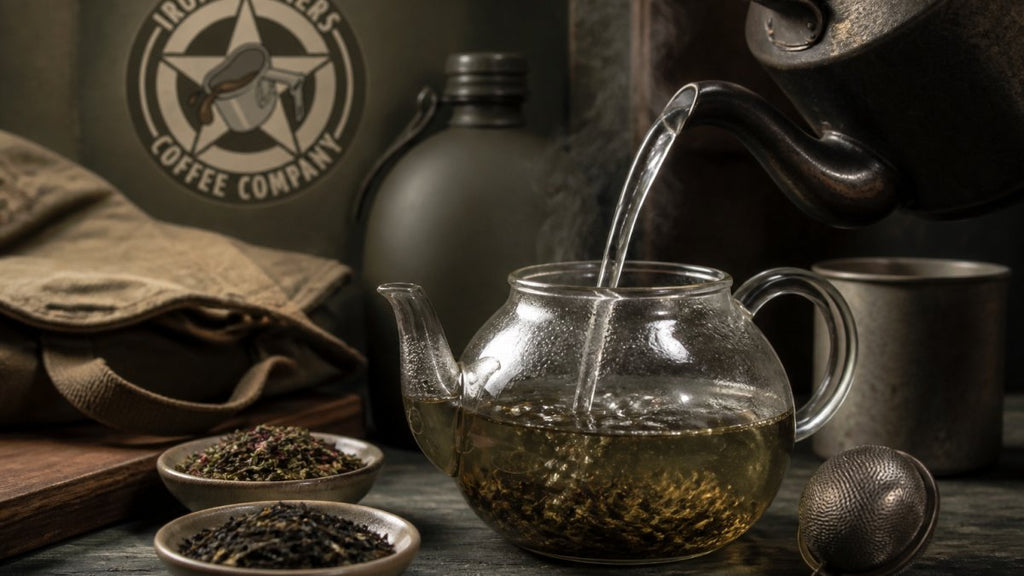
How to Brew the Perfect Cup of Loose Leaf Tea
Table of Contents
- How Much Loose Leaf Tea Per Cup: The Ration That Decides Everything
- Loose Leaf Tea Water Temperature: The Setting That Makes or Breaks the Brew
- Loose Leaf Tea Steeping Time: Reading the Leaves, Not Just the Clock
- Choosing Your Gear: Infusers, Strainers, and Teapots
- How to Brew Loose Leaf Tea Without an Infuser
- Troubleshooting Weak, Bitter, or Astringent Tea
- Storing Loose Leaf Tea: Keeping the Ration Fresh
- Frequently Asked Questions
Last Updated: October 15, 2026
How Much Loose Leaf Tea Per Cup: The Ration That Decides Everything
Getting the right amount of loose leaf tea per cup is the first order of business. The standard field ration is one teaspoon of loose leaves per 8 ounces of water, plus one extra teaspoon for the pot, the "one for the pot" rule.

At Iron Soldiers Coffee Company, we treat brewing like any operation: measure first, then execute.
Here is the working range:
- Light teas (white, green): 2 grams per 8 ounces
- Standard black and oolong: 2.5 to 3 grams per 8 ounces
- Herbal blends: 3 grams per 8 ounces, since dried fruit and flowers weigh less per scoop
Weight beats volume every time. A teaspoon of fluffy white tea and a teaspoon of dense black tea are not the same load.
Grams, Teaspoons, and Ounces: A Field Reference
Use this table as your supply sheet. It assumes an 8-ounce cup of water.
| Tea Type | Grams | Teaspoons | Ounces |
|---|---|---|---|
| White tea | 2 g | 1 heaped tsp | 0.07 oz |
| Green tea | 2 g | 1 tsp | 0.07 oz |
| Oolong | 2.5 g | 1 tsp | 0.09 oz |
| Black tea | 3 g | 1 heaped tsp | 0.11 oz |
| Herbal blend | 3 g | 1 heaped tsp | 0.11 oz |
Pro Tip
Weigh your leaves once with a kitchen scale, then note how that pile looks in your usual spoon. After two or three brews, you can hit the ration by eye without thinking about it.
Loose Leaf Tea Water Temperature: The Setting That Makes or Breaks the Brew
Water temperature is the single biggest lever on flavor, mattering more than steep time. Too hot, and delicate leaves scorch bitter; too cool, and they never open.
The rule of thumb: the darker and more processed the tea, the hotter the water.
- White and green tea: 175°F, below boiling
- Oolong: 185°F to 195°F
- Black tea and herbal blends: 195°F to 212°F, right off a rolling boil
No thermometer? Pull the kettle off just before a full boil for green and white teas and let it rest a minute or two.
Water Quality and Mineral Content: What Comes Out of the Tap
Filtered water makes better tea than straight tap water in most cases. Heavy minerals and chlorine flatten the aroma and leave a dull, chalky finish. Spring water with moderate mineral content is the gold standard, since the minerals help pull flavor from the leaves.
Distilled water is a poor choice: no minerals, thin taste. If your tap water smells like a swimming pool, run it through a carbon filter first.
Loose Leaf Tea Steeping Time: Reading the Leaves, Not Just the Clock
Loose leaf tea steeping time runs 2 to 3 minutes for green and white teas, 3 to 5 minutes for oolong, and 5 minutes or more for black and herbal blends.

Watch the color deepen and the leaves unfurl.
A common mistake is treating every tea the same: green tea left 5 minutes tastes like grass clippings, black tea pulled at 2 minutes tastes like hot water.
A Tea-Type Chart: Temperature and Time at a Glance
| Tea Type | Water Temperature | Steep Time | Re-steep? |
|---|---|---|---|
| White tea | 175°F | 2 to 3 min | Yes, 1 to 2 times |
| Green tea | 175°F | 2 to 3 min | Yes, 2 to 3 times |
| Oolong | 185°F to 195°F | 3 to 5 min | Yes, 3 to 4 times |
| Black tea | 195°F to 212°F | 5 min | Yes, 1 to 2 times |
| Herbal blend | 195°F to 212°F | 5 min | Rarely |
Key Takeaway
Temperature and time work as a pair. Drop the temperature and you can safely add time. Raise it, and you need to pull the leaves sooner.
Choosing Your Gear: Infusers, Strainers, and Teapots
Gear selection is a logistics problem: how much room your leaves get to unfurl, how fast you can clean up, and whether the tool matches your batch size. Loose leaves expand two to three times their dry size, so any vessel that pins them in a tight wad starves the center and produces a weak, uneven cup.
How the common options stack up:
| Method | Leaf Room | Batch Size | Cleanup | Best For |
|---|---|---|---|---|
| Fine-mesh strainer | High (leaves float free in the mug) | 1 cup | Rinse and tap out | Single servings, travel kits |
| Basket infuser | Medium to high, depends on basket depth | 1 to 2 cups | Rinse, occasional deep clean | Daily single or double cups |
| Tea ball | Low (leaves are compressed) | 1 cup | Fiddly, residue clings to seams | Emergency use only |
| Glass teapot with built-in strainer | High | 2 to 4 cups | Rinse pot, strainer lifts out | Small groups, watching the brew |
| French press | High | 2 to 4 cups | Full disassembly and rinse | Large leaves, herbal blends |
| Cast iron or ceramic teapot with wide infuser | High | 4 to 6 cups | Heaviest cleanup | Full-pot service |
Field notes:
- Fine-mesh strainer. The cheapest reliable option and the one that gives leaves the most open water. A strainer rated around 100 microns catches leaf dust a wide kitchen sieve lets through; look for stainless mesh with a firm rim that sits steady on the mug.
- Basket infuser. Depth is the whole game. A deep basket that hangs near the bottom of the mug lets leaves tumble and expand; a shallow one leaves the lower half dry. Measure your mug before you buy.
- Tea ball. The classic failure point. A ball packed more than half full compresses the leaves and blocks water from the center. Use it only when nothing else is on hand, and never fill it past half.
Pro Tip
Match the tool to the batch, not the other way around. If you brew one cup a day, a deep basket infuser and a fine-mesh strainer cover every tea you own. If you serve a full pot on weekends, a wide-infuser teapot earns its shelf space.
Watch Out
Do not pack a tea ball more than half full. The leaves swell, the water cannot reach the center, and you end up with a weak cup and a wasted scoop. The same rule applies to any basket that crowds the leaves against the wall.
One more consideration most guides skip: pre-warming. A cold mug or pot pulls heat out of the water the moment you pour, dropping your steep temperature by 10 to 20 degrees before the leaves ever open. Fill the vessel with hot tap water, let it sit 30 seconds, dump it, then brew.
How to Brew Loose Leaf Tea Without an Infuser
No infuser, no strainer, no problem. The field method needs only a mug, a second cup, and something to catch the leaves, the fallback we use when the kit is packed away, and it produces a cup every bit as clean as a basket brew when you follow the ratios.
Here is the step-by-step:
- Pre-warm the mug. Fill it with hot tap water, let it sit 30 seconds, dump it. A cold mug steals heat before the leaves open.
- Heat your water to the right temperature. Use the tea-type chart above: 175°F for white and green, 185°F to 195°F for oolong, 195°F to 212°F for black and herbal.
- Measure the leaves into the mug. Use the ration from the top of this guide: 2 grams per 8 ounces for white and green, 2.5 to 3 grams for black and oolong, 3 grams for herbal blends. Add the leaves dry, straight into the mug.
- Pour the hot water over the leaves. Pour in a steady stream and let the water agitate the leaves. Do not stir yet; the pour does the initial work.
- Cover the mug with a saucer. The saucer traps heat and aroma. A small plate or a second mug inverted over the top works just as well.
- Steep for the correct time, watching the color. Green and white: 2 to 3 minutes. Oolong: 3 to 5 minutes. Black and herbal: 5 minutes or more. Pull early if the liquor darkens faster than expected.
- Set a fine-mesh strainer over a second cup. If you have no strainer, see the pour-off method below.
- Pour the tea through the strainer to catch the leaves. Pour slowly and stop before the last ounce, where fine particles settle.
- Serve and enjoy. If you plan a second steep, leave the leaves in the first mug with a splash of hot water to keep them warm.
The Two-Cup Pour and the Fine-Mesh Strainer
The two-cup pour is the trick that makes this work: brew in one cup, then pour through a strainer into a second. The leaves stay behind and you get a clean cup with no grit.
A fine-mesh strainer catches even the smallest leaf fragments; a kitchen sieve with wide holes lets the dust through, so check the mesh before you commit.
No Strainer at All: The Settle-and-Decant Method
If you have nothing to strain with, gravity and patience still deliver a clean cup:
- Brew the leaves directly in the mug as above, but add one extra minute to the steep so the leaves fully settle.
- Let the mug rest undisturbed for 60 seconds after the steep time ends. The leaves sink to the bottom.
- Pour slowly into the second cup, tilting the mug just enough to start the flow and stopping the moment you see leaf matter approach the lip.
- Leave the last quarter-inch in the mug. That is where the sediment lives.
This method works best with large-leaf teas: oolong, whole-leaf black, and big herbal pieces. Fine-cut teas and fannings will cloud the cup no matter how carefully you decant, so save those for a strainer.
Adjusting the Method for Batch Size
The no-infuser method scales, but the ratios do not change. For a 16-ounce brew, double the leaf and add 30 seconds to the steep, since the larger volume holds heat longer. For a 12-ounce mug, use 3 grams for black tea and 2.5 grams for oolong, keeping the steep time the same. Always measure the water, not the mug; a mug that looks like 8 ounces often holds 10 or 12.
Key Takeaway
Without an infuser, the two variables you control are the pour and the clock. Pour slowly, stop before the sediment, and pull the leaves on time. The rest is the same discipline you use with a full kit.
Watch Out
Do not leave the leaves in the mug after the steep time ends. Without a basket to lift out, the leaves keep extracting tannins and the cup turns harsh within a minute or two. Pour off promptly, or the brew bites back.
Troubleshooting Weak, Bitter, or Astringent Tea
Weak tea usually means too little leaf, water too cool, or a steep cut short. Bitter or astringent tea almost always means the opposite: too much leaf, water too hot, or leaves left in too long.
Run through this checklist before you change anything else:
- Weak and pale: Add more leaf or raise the water temperature slightly.
- Bitter and sharp: Lower the temperature or shorten the steep.
- Dry, puckering astringency: You have pulled too many tannins. Cut the steep time and remove the leaves promptly.
Change one variable at a time. Change the leaf, the water, and the time all at once, and you will never know which fix worked.
Storing Loose Leaf Tea: Keeping the Ration Fresh
Loose leaf tea goes stale the same way coffee does: air, light, heat, and moisture. Store it in an airtight container away from the stove and out of direct sunlight.
Keep these points in mind:
- Buy in small amounts you will finish within a few months.
- Keep the container sealed between scoops.
- Store away from strong spices, since tea picks up nearby odors.
Fresh leaves unfurl better and give a cleaner cup. Stale leaves brew flat no matter how well you measure.
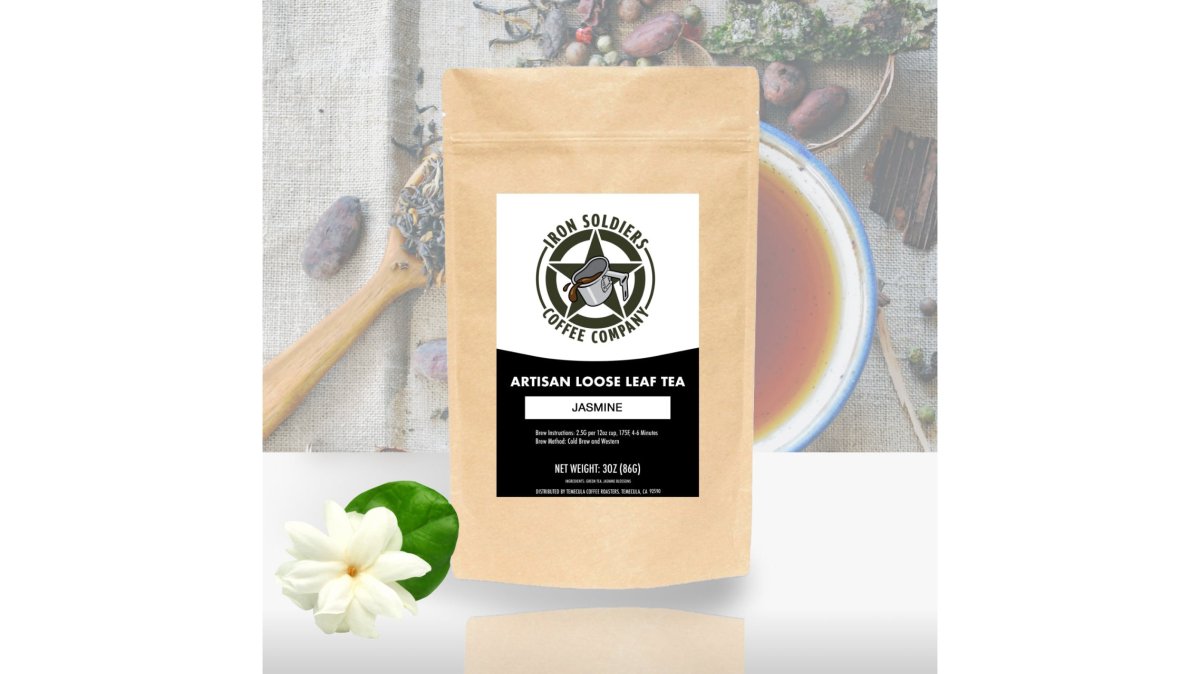
If you want a blend built for a proper steep, our Peach Paradise Loose Leaf Tea is a fruity herbal blend that takes 5 minutes at 195°F to 212°F using 2.5 to 3 grams per 12 ounces of water, and it works just as well chilled over ice. For a lighter, greener cup, our Jasmine Loose Leaf Tea steeps at 175°F for 4 to 6 minutes and holds up to multiple steepings.
Brewing a great cup comes down to control: the right ration, the right temperature, and the right time, every time. Browse the full lineup, including our bold English Breakfast and spiced Masala Chai, and find the blend that fits your routine.

Frequently Asked Questions
How much loose leaf tea should I use for one cup?
The standard ration is 2.5 to 3 grams of loose leaf tea per 12 ounces of water, which is about 1 teaspoon for most teas. Denser teas like Masala Chai may need slightly less volume, while large-leaf white or oolong teas need more. If you do not own a scale, start with 1 teaspoon and adjust after tasting. A kitchen scale removes the guesswork entirely and costs less than a single tin of tea.
Can you brew loose leaf tea without an infuser?
Yes. Add the leaves directly to a mug or teapot, pour hot water over them, and let them steep. When time is up, pour the tea through a fine-mesh strainer into a second cup, leaving the spent leaves behind. This method works with any loose leaf tea and requires no special equipment beyond a strainer. It is the oldest field method there is, and it still produces a clean, full-flavored cup.
How long should loose leaf tea steep?
Steeping time depends on the tea type. Green and white teas need 2 to 3 minutes, oolong sits between 3 and 5 minutes, and black or herbal blends run 5 minutes or longer. Over-steeping is the most common cause of bitterness, so set a timer rather than guessing. When in doubt, pull the leaves early and add time on the next steep.
Can you steep loose leaf tea more than once?
Most loose leaf teas can be re-steeped two or three times, and some oolong and green teas hold up for four or more. Add roughly 30 seconds to each subsequent steep and use the same leaf-to-water ratio. The second steep often tastes smoother than the first because the strongest tannins have already released. Discard the leaves once the flavor turns flat or woody.