How to Support Military Families Through Daily Habits
Last Updated: November 10, 2026
Quick Summary
To support military families, focus on small, steady daily habits rather than one big gesture. Keep predictable routines around three anchor points: wake-up, dinner, and bedtime. Offer specific help like a weekly meal drop-off or school pickup, and check in with a short daily text. Consistency keeps the whole household in formation.
- Lock in three anchors first: wake-up, dinner, and bedtime, then build the rest of the day around them.
- Post the family schedule where kids can see it and review it every Sunday.
- Offer one specific favor, such as a Tuesday dinner or school pickup, rather than a vague offer of help.
- Iron Soldiers Coffee Company donates $1 from every bag sold to a volunteer-only nonprofit supporting veterans and their families.
- Confirm before visiting, since a surprise visit can add work for a household already stretched thin.
Want to help military families every day?Iron Soldiers Coffee Company donates $1 from every bag to a volunteer-only veteran nonprofit.
Shop Veteran-Supporting Coffee
Table of Contents
- Why Daily Habits Matter for Military Families
- How to Build a Predictable Daily Routine for a Military Household
- How to Share Meals and Protect Family Mealtime
- Military Family Mental Wellness Tips for Everyday Life
- Community Support for Military Spouses: Practical Ways to Help
- How to Offer Help Respectfully Without Adding Work
- Start Your Own Support Routine This Week
- Frequently Asked Questions
Why Daily Habits Matter for Military Families
Every military family runs on routine, even when the orders keep changing. Supporters across the country often ask the same question: what can I actually do, day to day, to support military families? The answer is simpler than most people expect. Small, steady habits do more good than one big gesture.
Think of it like a formation. One soldier out of step is noticeable. A whole line drifting is a problem. Consistency keeps the line straight.
Family routines matter because they give children a sense of order when a parent is away or moving. A predictable schedule takes some of the guesswork out of the day. It also gives the at-home parent a little breathing room.
Here is what steady daily habits usually provide:
- A sense of stability when deployments and moves disrupt everything else
- Regular points of connection between family members
- Fewer decisions to make at the end of an exhausting day
- A clear way for friends and neighbors to plug in and help
Watch out: Good intentions can turn into extra work for a busy spouse. Ask before you show up with help.
How to Build a Predictable Daily Routine for a Military Household
A workable routine starts with three anchor points: wake-up, dinner, and bedtime. Lock those in first, then build everything else around them. Anchors matter more in military households because the outside schedule can change without notice, so the anchors become the part of the day that stays fixed no matter what orders arrive.
Write the anchors on a single sheet, then add the recurring commitments: school drop-off, practice nights, work shifts, and any regular appointments. Keep the sheet where everyone can see it, and make it short enough to read at a glance. A color for each person works well for younger children.
How the routine should look depends on the stage the family is in. During deployment, the at-home parent often benefits from a routine that protects one or two personal blocks each day, such as a walk or a quiet hour, because the household load is usually heaviest. During reintegration, the routine should make room for the returning service member to reconnect with each child, often through a fixed evening activity, while accepting that the first few weeks may feel uneven. Before a move, the routine can shift toward preserving bedtime and meal times, since those anchors give children stability while everything else is in boxes.
Follow these steps to build the routine:
- Pick a consistent wake-up time, even on weekends
- Set a fixed dinner window, ideally the same time most nights
- Create a 20-minute wind-down before bed with the same sequence each night
- Post the schedule where kids can see it
- Review it every Sunday and adjust for the week ahead
A civilian supporter can reinforce the routine without taking it over. Offering to handle one anchor, such as a Tuesday dinner, supports the schedule instead of replacing it. Asking what time the household usually eats helps you show up at a time that fits.
Routines fail when they are too rigid. Build in one flexible slot each day so a missed appointment or late shift does not derail everything. Single-parent households and caregivers often need even more flexibility, so consider a routine that names the non-negotiable anchors and leaves the rest open.
Watch out: copying another family's schedule rarely works, because the number of children, their ages, and the parent's shift pattern all change what fits.
How to Share Meals and Protect Family Mealtime
Shared meals are one of the simplest ways to keep a military family connected. When one parent is deployed, a supporter can help by dropping off a meal or inviting the kids over for dinner once a week.
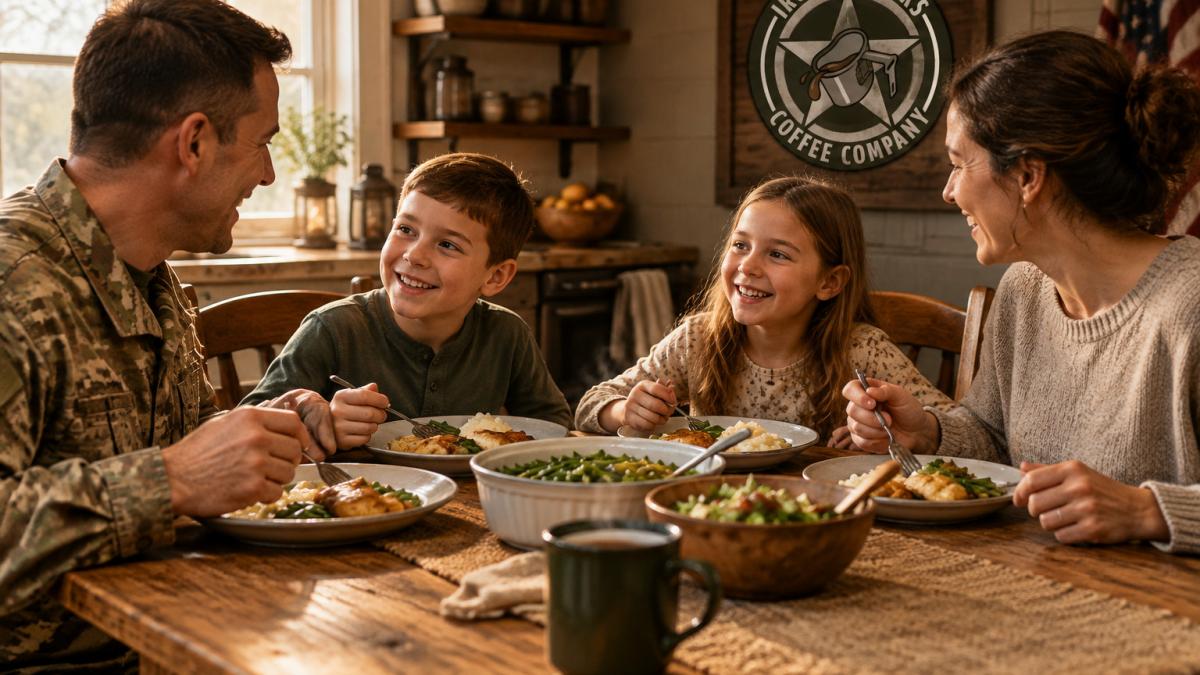
A family of four sharing a simple home-cooked meal around a wooden kitchen table, warm lighting, a steaming mug of coffee nearby
Keep it low pressure. A casserole, a pot of soup, or a batch of chili freezes well and can be dropped off without a long visit. Pair it with a cup of coffee for the adults, and you have a small gesture that feels like real care. Browse coffee picks for deployed care packages to find a warm gift to add.
Protect mealtime by putting phones away and asking each person about their day. Those five minutes often reveal more than a week of text messages.
Shared meals and protected mealtime are simple ways to keep a military family connected. Here is what each gesture looks like in practice.
| Gesture | Best for | Key detail |
|---|---|---|
| Drop off a casserole, soup, or chili | Busy households | Freezes well; no long visit needed |
| Invite the kids to dinner once a week | Deployed-parent households | Keep it low pressure |
| Pair a meal with coffee for the adults | Spouses carrying the load | Small gesture that feels like real care |
| Put phones away at dinner | Every family | Five minutes often reveals more than a week of texts |
Military Family Mental Wellness Tips for Everyday Life
Stress in military households often builds quietly. Kids may act out, and spouses may hide how tired they are. Watching for these signs helps supporters step in early.
Simple habits that support mental wellness include:
- Short daily check-ins, even a two-minute text
- Outdoor time for kids and adults, such as a walk around the block
- Sleep routines that stay the same, even when the household is chaotic
- Permission to talk about worries without judgment
Mental health concerns can run deep. When stress begins to affect sleep, school, or daily function, encourage the family to reach out to a qualified professional.
Community Support for Military Spouses: Practical Ways to Help
Military spouses often carry the household alone for months at a time. Practical help, offered consistently, is one of the best ways to support military families, and it can mean more than a sympathy card.
Consider these specific offers:
- Babysitting so a spouse can attend an appointment or take a break
- Running errands like grocery pickup or pharmacy trips
- Mowing the lawn or shoveling the driveway
- Inviting the spouse and kids to a low-key outing
Donations also make a difference. Iron Soldiers Coffee Company donates $1 from every bag sold to a volunteer-only nonprofit that supports veterans and their families. Before giving to any charity, it is smart to check that the organization is legitimate and that funds go where it says they do. Learning how to verify charity coffee donations is a good first step for conscious shoppers.
For more practical ideas, see our guide on organizing coffee fundraisers for veterans, or explore career development resources for transitioning service members if a family is facing a move or a new career chapter.
How to Offer Help Respectfully Without Adding Work
The best support is easy to accept, and it changes shape depending on where a family is in the military life cycle. During a deployment, the at-home parent often needs repeatable, low-effort help: a standing dinner drop-off on Tuesdays, a weekly pickup from school, or a check-in text at the same time each morning. During a move, the family is juggling packing, school enrollment, and unfamiliar neighborhoods, so help that involves local knowledge, such as recommending a pediatrician or pointing out the nearest pharmacy, is often more useful than general offers. During reintegration, the returning service member and the household are readjusting to each other, and the most helpful supporters usually step back, keep their visits short, and let the family set the pace.
Ask for specifics rather than offering a vague "let me know if you need anything." Vague offers put the work of deciding on the spouse, who is already carrying the most. Try wording like: "I'm free Thursday afternoon. Can I pick up the kids from school?" That gives the family a clear yes or no and takes less than a minute to answer.
Follow through exactly as promised. If you say you will drop off soup at 5:30, arrive at 5:30 and leave the container with a note about reheating. A missed commitment costs a stretched-thin household more than no offer at all.
Support needs to fit varied household structures. A single parent may need help with bedtime routines or a few hours of respite rather than meals. A grandparent or other relative acting as a caregiver may need someone to cover a weekly appointment so they can rest. Families far from base or without nearby relatives may depend on a neighbor or friend more than anyone else, which makes a small, steady presence especially meaningful. Children of different ages need different things too: a toddler may need a familiar sitter, while a teenager may simply need a ride to practice and a listening ear.
Respect privacy. Not every family wants visitors, and some prefer phone calls, texts, or leaving things on the porch. Ask how they like to be supported, and follow their lead. Keep a simple note on your phone listing which gestures landed well and which felt like noise, so your help improves over time without asking the family to explain themselves again.
Watch out: a surprise visit can add cleaning, hosting, or explaining to a family that was already stretched thin, so confirm before you arrive.
Start Your Own Support Routine This Week
You do not need to overhaul your life to support a military family. Pick one habit from this guide and commit to it for seven days. Send one check-in text each morning. Drop off one meal. Offer one specific favor.
Consistency is what turns a kind thought into real support. Every bag sold helps support veterans and their families, and we hope this guide helps you show up for them too. Start small, stay steady, and keep the line straight.
Ready to make your daily cup count? Shop Iron Soldiers Coffee Company's full lineup and support veterans with every sip. Shop All Coffee
Frequently Asked Questions
What are the most effective ways to support military families daily?
Consistent, small actions work best: bring a meal, offer to run an errand, or check in by phone on a set day each week. Predictability matters more than grand gestures, because families under deployment stress benefit most from steady routines. Ask the family what would help most, then follow through on the specific offer you make. Keep your help low-effort for them so it adds to their stability rather than their to-do list.
How can civilians provide meaningful support to service members' families?
Start by offering concrete help instead of a general 'let me know if you need anything.' Examples include babysitting for an evening, driving children to practice, or picking up groceries. Respect privacy and avoid asking for details about the deployment. Consistency over several months often means more than a single large effort, and following through on small promises builds trust.
How do community members help reduce stress for military spouses?
Community members can reduce stress by taking on recurring tasks such as yard work, school pickups, or appointment rides. Invitations to shared activities, like a weekly family dinner or a neighborhood walk, provide social connection. Pointing spouses toward local military family resources can also save time. Keep offers specific and easy to accept, and check in again if the first offer is declined.
Can supporting a military family through daily habits help children too?
Yes. Predictable bedtimes, regular meal times, and consistent homework schedules give children a sense of stability during a parent's absence or a move. Supporters can help by keeping activities on the same day each week and by maintaining familiar traditions. Children also benefit from adults who listen without pressing them to talk about the deployment.