5 Best Coffee Bean Storage Containers Reviewed for 2026
Table of Contents
- Quick Comparison: 5 Best Coffee Bean Storage Containers
- Impact of Oxygen on Coffee Flavor Profile
- Coffee Bean Storage Best Practices
- How to Store Coffee Beans for Maximum Freshness
- The 5 Best Coffee Bean Storage Containers Reviewed
- Common Mistakes to Avoid When Choosing a Container
- Frequently Asked Questions
Last Updated: September 28, 2026
Quick Comparison: 5 Best Coffee Bean Storage Containers
The right coffee bean storage container decides whether your morning brew tastes like a fresh roast or a dusty ration tin. Oxygen is the enemy, and it starts its work the moment a bag is opened. This guide from Iron Soldiers Coffee Company walks through the science, the field-tested habits, and the hardware that keeps beans mission-ready.

Below is the short version for readers who already know the drill:
| Container Type | Seal Method | Best For | Watch Out For |
|---|---|---|---|
| Vacuum canister | Pump removes air | Long-term storage | Bulky, needs power or manual pump |
| Airtight stainless steel | One-way valve + gasket | Daily brewing | Heavier than glass |
| Ceramic | Silicone gasket | Countertop display | Can chip, limited capacity |
| Borosilicate glass | Clamp lid | Visual inventory | Light exposure if clear |
| Bag clip + original bag | Rolled fold | Short-term only | Poor seal integrity |
Impact of Oxygen on Coffee Flavor Profile
Oxygen is the primary saboteur of stored coffee. The moment a roast is exposed to air, oxidation begins breaking down the lipids and volatile aromatic compounds that carry the flavors you paid for. The process is not instant, but it is relentless, and it accelerates with heat, light, and surface area.
Carbon dioxide is the second variable. Fresh beans release CO2 for several days after roasting, a process called degassing. Trap that gas in a fully sealed jar and pressure builds, forcing aromatics out of the bean and into the headspace, where they turn flat and papery. A one-way valve solves this: it vents CO2 out while blocking oxygen from coming back in. That is why nearly every serious canister on the market pairs an airtight gasket with a valve.
Roast profile changes the clock. This is the variable most storage guides skip entirely. Dark roasts are roasted longer and develop more porous cell structure, so they degas faster and oxidize faster, often peaking within 7 to 10 days off roast. Light roasts are denser, retain more CO2, and can hold peak flavor for two to three weeks. If you brew light roasts, your container has more margin. If you brew dark roasts, seal integrity and one-way venting are non-negotiable.
Light and UV exposure compound the damage. Ultraviolet light accelerates the breakdown of volatile compounds and can trigger rancidity in the bean's oils. This is why opaque materials, stainless steel, ceramic, or dark-tinted glass, outperform clear glass for anything stored longer than a week. A clear canister on a sunlit counter is a slow-motion flavor leak.
Moisture is the quiet third front. Beans are hygroscopic, meaning they absorb water from the air. A pantry that swings between humid summer and dry winter will stress even a good gasket. Condensation inside a container, common when beans are moved from a cold fridge to a warm kitchen, ruins texture and accelerates staling faster than oxygen alone.
Watch Out
Storing beans in the hopper of your grinder exposes them to oxygen and light all day. That is fine for a single day's batch, but a full week in the hopper will flatten even a fresh roast. Treat the hopper as a staging area, not a storage solution.
If you buy in bulk, split your supply. Keep a small daily-use container on the counter and store the rest in a vacuum-sealed portion in the freezer. Every time you open a bulk container, you exchange its headspace air for fresh oxygen, so open it as few times as possible.
Coffee Bean Storage Best Practices
Coffee bean storage best practices come down to four controls: air, light, heat, and moisture. Master those and your beans hold their flavor profile far longer.
- Keep beans in an opaque, airtight container at room temperature
- Store whole bean, not grounds, until brew time
- Keep the container away from the stove, oven, and windowsill
- Buy in batches sized to your daily brewing habit
- Never refrigerate daily-use beans; condensation ruins them
Moisture control is the quiet one. A pantry that swings between humid and dry will undo a good seal. A cool, dark cabinet beats a decorative countertop spot every time.
How to Store Coffee Beans for Maximum Freshness
To store coffee beans for maximum freshness, seal them in an airtight container with a one-way valve, keep that container out of light and heat, and grind only what you brew.
Here's a field checklist worth running through:
- Transfer beans out of the original bag within a day of opening
- Confirm the lid seals with a gasket, not just friction
- Check for a one-way valve if beans are less than two weeks off roast
- Label the container with the roast date
- Keep the container below eye level in a dark cabinet
- Clean the canister every two weeks to prevent oil buildup
Shelf life is a range, not a rule. Whole beans hold peak flavor for a few weeks after roast, then fade gradually. Grounds lose their edge within days.
Freeze beans only for long-term storage, and only in a vacuum-sealed portion. Once thawed, use the whole portion. Refreezing introduces moisture that no gasket can fix.
The 5 Best Coffee Bean Storage Containers Reviewed
Here are five container types worth considering, ranked by how well they protect bean freshness in daily use. Each entry covers the seal mechanism, the material trade-offs, the capacity math, and the workflow it actually fits, because the right container for a dark-roast espresso drinker is not the right container for a light-roast pour-over brewer.
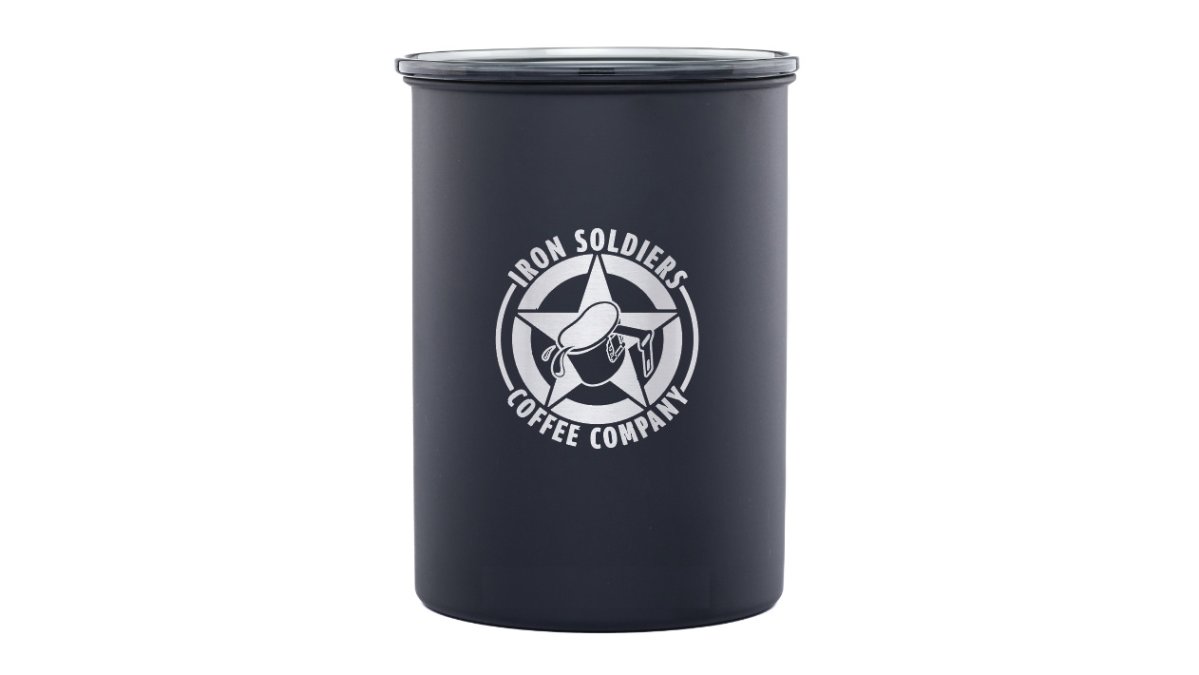
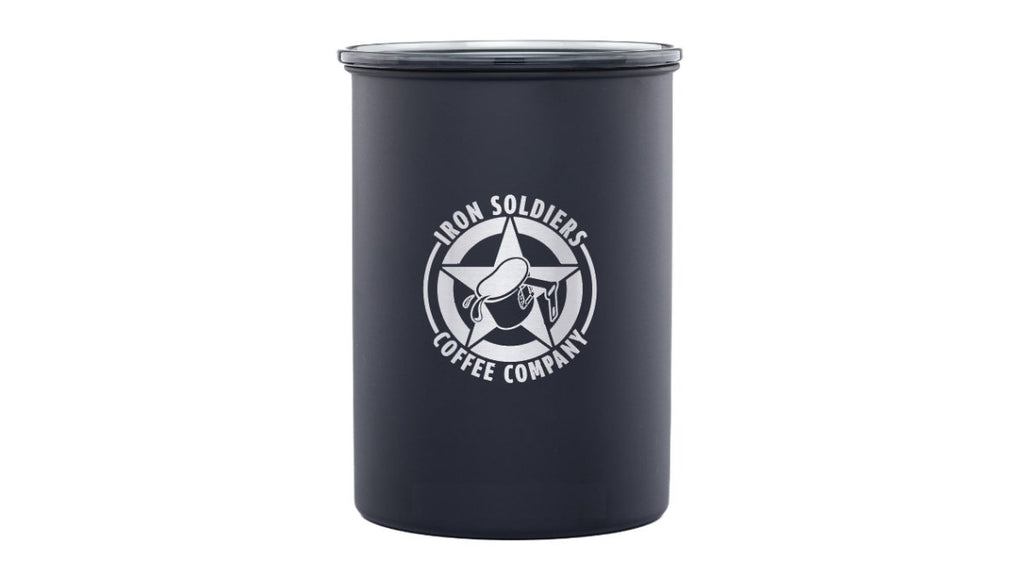
1. Iron Soldiers Coffee Company A210 Airscape Stainless Steel Medium Container
A210 Airscape Stainless Steel Medium →
Our top pick. The A210 uses patented airtight technology that removes oxygen from the container, which is the single most important job a canister has. The 64 fl. oz. medium holds one pound of whole bean coffee, and the food-grade stainless steel body blocks the light that degrades flavor.
It ships with the Airscape Cotton Refill Bag, so you can fill up at a local roaster and skip the retail bag entirely. The engraved Iron Soldiers logo gives it a proper barracks-ready look, and it works just as well for tea, flour, or spices. At $32.40, it is the container we reach for first.
2. Vacuum-Sealed Canisters
Battery or manual pump models pull air out and hold a strong vacuum. They are the best option for batch storage you will not touch for weeks. The trade-off is bulk and upkeep: pumps wear out, gaskets degrade, and the containers take up serious countertop footprint. Look for a model with a replaceable gasket and a pump that uses standard batteries rather than a proprietary charger. Best for the long-term bulk buyer who portions out weekly.
3. Borosilicate Glass Canisters
Glass will not hold odors or stain, and it is easy to clean. Clear glass, though, lets light through, so store these inside a cabinet rather than on an open shelf. Look for a clamp lid with a silicone gasket for real seal integrity. Capacity typically runs 32 to 64 fl. oz. Best for the brewer who wants to see inventory at a glance and does not mind keeping it in a dark cabinet.
4. Ceramic Canisters
Ceramic blocks light and looks sharp on a countertop. Capacity tends to run small, often 16 to 32 fl. oz., which is roughly half a pound of beans, and a dropped lid ends the mission early. Best for households brewing a few cups a day who want the container to earn its counter space aesthetically. Check that the lid seats with a gasket, not just friction.
5. Original Bag with a Clip
The cheapest option, and the weakest. Rolled folds leak air, and most retail bags do not reseal well once opened. Fine for a week, not for a month. If you must use it, squeeze out as much air as possible before clipping, and keep the bag in a dark cabinet. This is a field expedient, not a storage plan.
Matching the container to your workflow. Daily-use brewers should prioritize a one-way valve and easy one-handed opening. Long-term bulk buyers should prioritize vacuum seal and freezer compatibility. Light-roast drinkers have more margin on seal quality; dark-roast drinkers should treat the valve and gasket as the deciding features. Match the tool to the mission.
Common Mistakes to Avoid When Choosing a Container
Most buyers focus on looks and miss the mechanics. A common mistake is buying a container with no one-way valve, then wondering why fresh beans taste flat within days.
Key Takeaway
Buy for seal integrity and light protection first, aesthetics second. A plain container that keeps oxygen out beats a handsome one that doesn't.
Frequently Asked Questions
What is the best container to store coffee beans in?
The best container blocks oxygen, light, heat, and moisture. Look for an airtight canister with a one-way valve, such as the A210 Airscape Stainless Steel Medium Coffee Container. Its patented technology removes oxygen, and the stainless steel body blocks light. It holds 1 lb of whole beans and includes a cotton refill bag. For daily use, a vacuum-sealed or airtight container with a silicone gasket keeps beans fresh for weeks.
How long can you store coffee beans in a vacuum-sealed container?
Whole beans stored in a vacuum-sealed container can stay fresh for up to 3-4 weeks at room temperature. For longer storage, freeze the container. Oxygen exposure is the main enemy of freshness, so removing air delays staleness. Always check the seal integrity and keep the container in a cool, dark place. The A210 Airscape container removes oxygen and protects against light degradation, helping maintain flavor profile.
Do airtight containers actually keep coffee beans fresh longer?
Yes. Airtight containers limit oxygen exposure, which slows oxidation and preserves aroma and flavor. They also block moisture and light, two other enemies of freshness. However, not all airtight containers are equal. Look for a silicone gasket and a one-way valve to release carbon dioxide during degassing. The A210 Airscape uses patented airtight technology to remove oxygen, keeping beans fresh for daily brewing.
Should coffee beans be stored in the original bag or a canister?
The original bag often has a one-way valve but is not resealable after opening, exposing beans to oxygen. Transferring beans to an airtight canister like the A210 Airscape provides better protection. If you keep the bag, squeeze out air and seal it tightly, then place it inside an opaque container. For maximum freshness, use a dedicated coffee bean storage container with UV protection and moisture control.
Related post
21
Oct
20
Oct