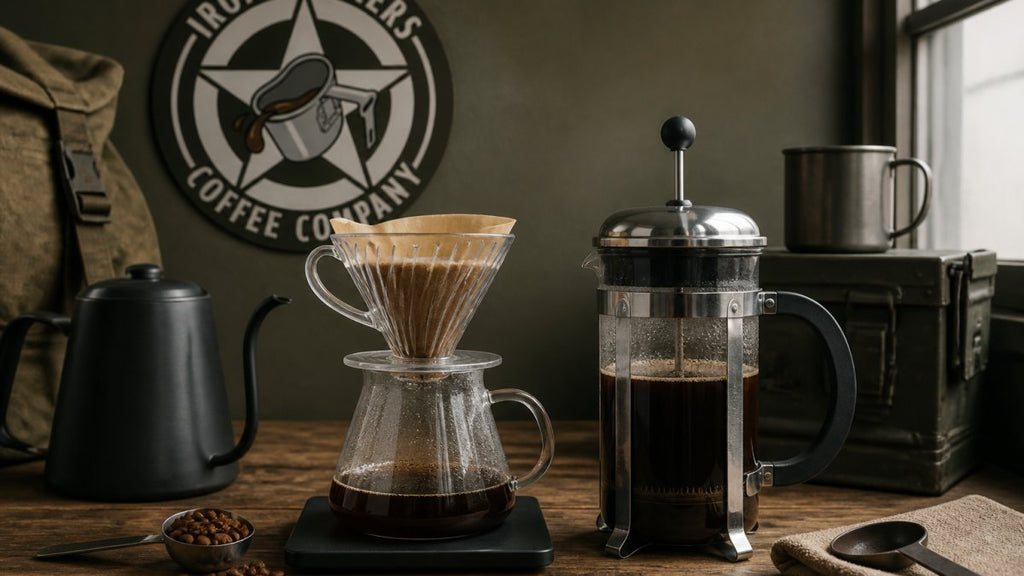
Pour Over vs French Press for Beginners: 2026 Guide
Table of Contents
- Pour Over vs French Press for Beginners: The Briefing
- Head-to-Head Comparison Table
- Flavor Profile and Mouthfeel: Clarity vs. Body
- Best Grind Size for French Press and Pour Over
- Equipment, Cost, and Time: What Beginners Actually Need
- How to Brew Strong Coffee in Either Method
- Cleaning, Maintenance, and Environmental Impact
- Common Mistakes and Grind Size Troubleshooting
- Frequently Asked Questions
Last Updated: October 2, 2026
Pour Over vs French Press for Beginners: The Briefing
If you are new to manual brewing, the pour over vs french press decision comes down to one question: do you want clarity or body? The pour over coffee vs french press for beginners comparison is the first real fork in the road for anyone stepping away from a drip machine. This briefing from Iron Soldiers Coffee Company covers both methods side by side so you can pick your equipment once and brew with confidence.
Here is the short version. Pour over is a paper-filter method that produces a clean, bright cup with sharp tasting notes. French press is an immersion method that keeps the oils and sediment in the brew, giving you a heavy, full-bodied cup.
Below, we walk through grind size, gear, brew time, cleanup, and the mistakes that trip up most new brewers. By the end you will know exactly which method fits your kitchen and your morning schedule.
Head-to-Head Comparison Table
The fastest way to choose is to see both methods lined up. Use this table as your field map, then read the sections below for the details behind each row.
| Factor | Pour Over | French Press |
|---|---|---|
| Flavor profile | Clarity, bright notes, acidity | Full-bodied, rich mouthfeel |
| Filter | Paper filter | Metal mesh filter |
| Grind size | Medium-fine grind | Coarse grind |
| Brew time | 3-4 minutes | 4 minutes steep, then press |
| Skill level | Moderate | Beginner-friendly |
| Cleanup | Toss filter, quick rinse | Rinse mesh, more sediment |
| Gear needed | Dripper, paper, gooseneck kettle | Press, spoon, kettle |
| Best for | Tasting notes, single origin | Strong, heavy daily cup |
Flavor Profile and Mouthfeel: Clarity vs. Body
Flavor is where these two methods split hardest.

Think of it like a briefing versus a full report. The pour over hands you the key points, sharp and separated. The French press hands you everything at once, dense and complete.
If you drink single origin coffee and want to taste the dried orange and sweet berries in a medium roast, pour over is your method.
Best Grind Size for French Press and Pour Over
Grind size is the single biggest variable a beginner controls, and it is the one most people get wrong. The rule is simple: the longer the coffee touches water, the coarser the grind.
Get this wrong and the cup punishes you. Too fine in a French press and the mesh clogs, the plunger fights back, and you end up with muddy, bitter coffee.
Coarse Grind for the French Press
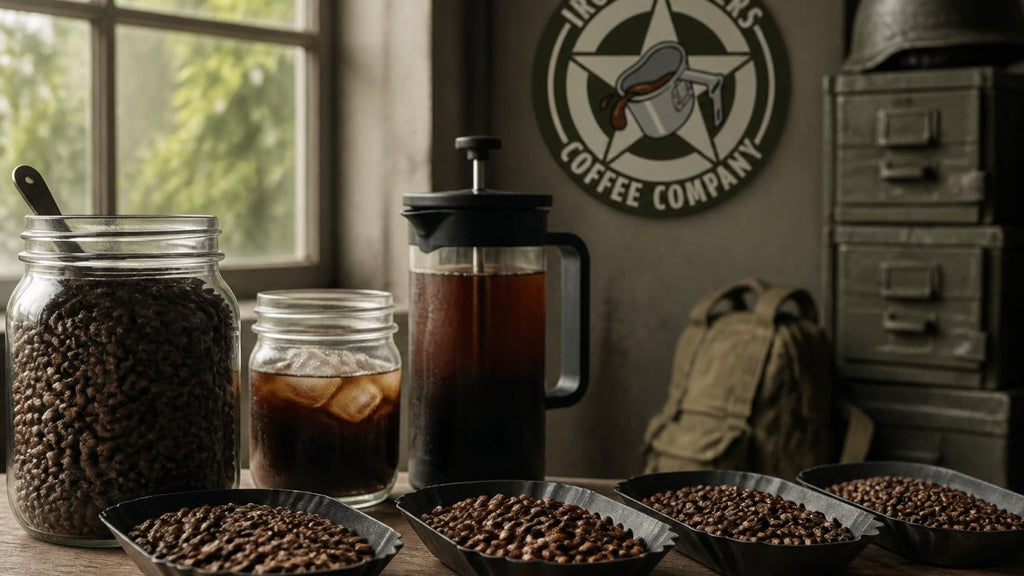
Coarse grind looks like sea salt or rough breadcrumbs. Individual particles are large enough that the mesh filter catches them while still letting oils pass. If your press feels hard to push down, your grind is too fine. Back it off a notch.
Medium-Fine Grind for Pour Over
Medium-fine grind sits between table salt and sand. It gives water enough surface area to extract flavor in three to four minutes without stalling the drain. If your pour over takes longer than five minutes, your grind is too fine and the cup will taste bitter.
Pro Tip
Buy a burr grinder before you buy a better dripper. A consistent grind fixes more bad cups than any piece of brewing hardware, and a cheap blade grinder will leave you with both dust and boulders in the same batch.
Equipment, Cost, and Time: What Beginners Actually Need
You do not need a wall of gear to start. Both methods need only a few items, and the French press is the simpler entry point because it skips the paper filters and the gooseneck kettle.
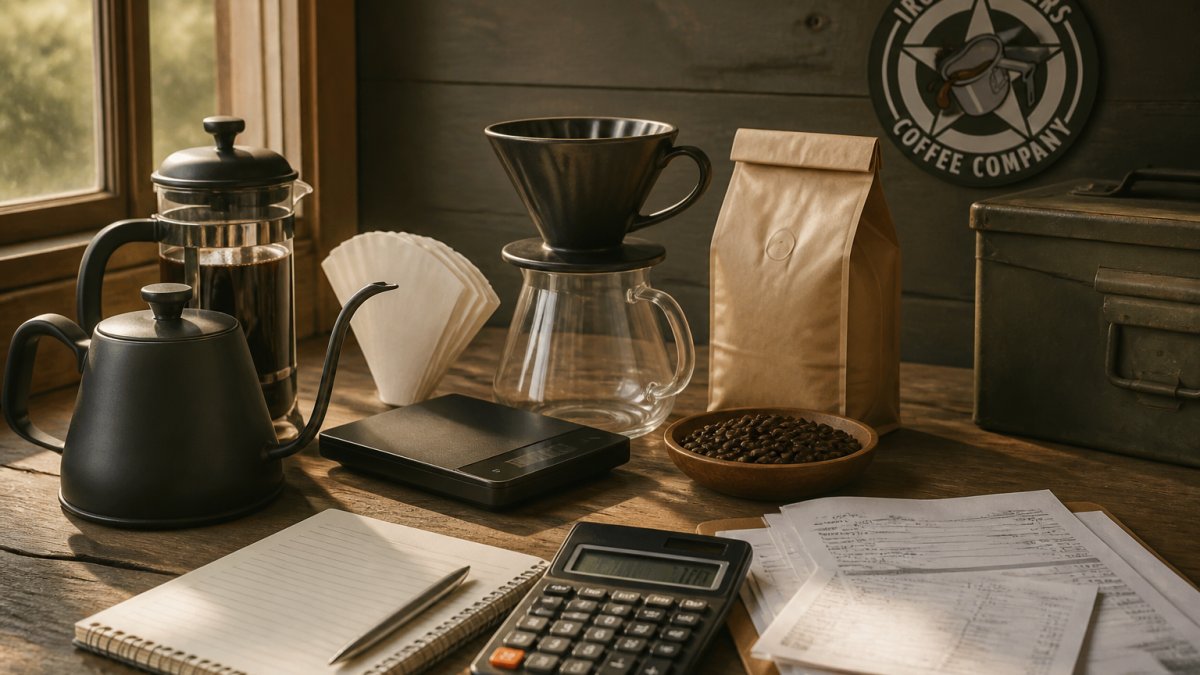
French press kit:
- Press (glass or stainless, 12-32 oz)
- Kettle (any spout works)
- Long spoon for stirring
- Digital scale accurate to 0.1 g
- Burr grinder (hand or electric)
Pour over kit:
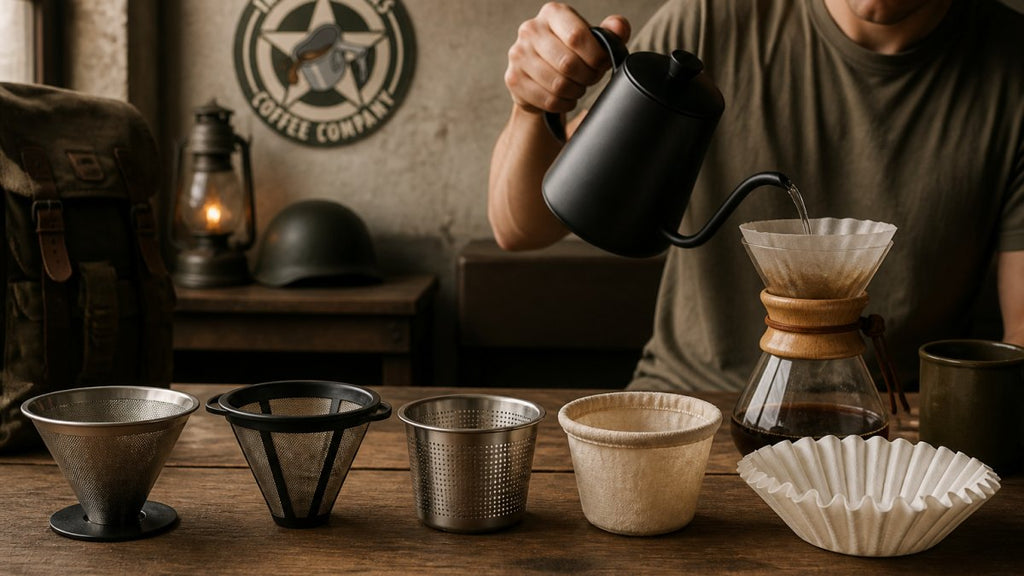
- Dripper (cone or flat-bottom)
- Paper filters sized to the dripper
- Gooseneck kettle for controlled pouring
- Digital scale accurate to 0.1 g
- Burr grinder (hand or electric)
The gooseneck kettle is not optional for pour over. A wide spout dumps water in a rush and wrecks your extraction. For the press, any kettle will do because you are pouring all the water at once.
The Beginner Recipe for Each Method
This is where most guides wave their hands. Here are the exact numbers to start with. Use a 1:15 ratio by weight, one gram of coffee to fifteen grams of water. For a standard 12 oz mug, that means about 22 g of coffee and 340 g of water.
French press (4-minute steep):
- Weigh 22 g coffee, grind coarse (sea salt texture).
- Heat water to 200°F, just off a boil.
- Add coffee to the press, then pour all 340 g of water.
- Stir once, place the lid, and steep 4 minutes.
- Press slowly over 20-30 seconds and pour immediately.
Pour over (3-4 minute brew):
- Weigh 22 g coffee, grind medium-fine (table salt texture).
- Heat water to 200°F.
- Rinse the paper filter with hot water, then discard the rinse.
- Add coffee, then pour 45 g of water for the bloom. Wait 30 seconds.
- Pour in slow circles in stages until you reach 340 g total.
- Let it drain fully, target 3 to 4 minutes total.
Time Commitment
The French press asks for about four minutes of steeping and almost no attention, you can walk away. The pour over asks for three to four minutes of active pouring in stages, so you stay at the counter. If your mornings are chaos, the press is more forgiving.
Which One Fits Your Kitchen
Choose the French press if you want the lowest-friction start, the fewest pieces of gear, and a forgiving brew you can make half-asleep. Choose the pour over if you want to taste what a single origin is doing, you do not mind standing at the counter for four minutes, and you are willing to buy one extra piece of gear, the gooseneck kettle.
Key Takeaway
The French press is the easier first mission: fewer parts, less attention, more forgiving. The pour over is the precision assignment: more gear, more focus, and a cleaner, more detailed cup. Pick based on your patience, not your budget.
How to Brew Strong Coffee in Either Method
Strong coffee comes from the ratio and the grind, not from dumping in extra scoops. The standard starting point is a coffee-to-water ratio of roughly 1:15 by weight, meaning one part coffee to fifteen parts water. From there you adjust to taste.
Here is the field procedure for each method.
French press:
- Weigh your coffee and water at a 1:15 ratio.
- Grind coarse.
- Add coffee, then pour water just off a boil.
- Stir once, place the lid, and steep for four minutes.
- Press slowly and pour immediately.
Pour over:
- Weigh your coffee and water at the same ratio.
- Grind medium-fine.
- Place the paper filter and rinse it with hot water.
- Add coffee and pour a small bloom of water, then wait 30 seconds.
- Pour in slow circles until you hit your water weight.
Water temperature matters in both. Aim for just off a boil, around 200 degrees Fahrenheit. Boiling water scorches the grounds and adds bitterness.
Watch Out
Do not leave brewed coffee sitting on the French press grounds. It keeps extracting and turns bitter within minutes. Pour the entire press into a carafe as soon as you finish pressing.
Cleaning, Maintenance, and Environmental Impact
Cleanup separates the two methods more than most beginners expect. A pour over is nearly self-cleaning: lift the paper filter with the grounds inside, toss it, and rinse the dripper.
For the press, disassemble the plunger and rinse each mesh screen under running water after every use.
Environmental impact favors the French press. The metal mesh filter is reusable for years, so there is no paper waste per brew.
Common Mistakes and Grind Size Troubleshooting
Most beginner problems trace back to grind size, water temperature, or ratio, not to the equipment. This section is your field repair manual. Use it to diagnose a bad cup fast, method by method.
Why Does My Coffee Taste Bitter?
Bitterness almost always means over-extraction: too much flavor pulled from the grounds. In a French press, the usual cause is a grind that is too fine, which lets the mesh pass too many particles and keeps extracting even after you press. In a pour over, bitterness usually means the water sat in the bed too long because the grind was too fine and stalled the drain.
French press fixes:
- Coarsen the grind one notch.
- Shorten the steep from 4 minutes to 3:30.
- Pour off the brewed coffee immediately after pressing, do not let it sit on the grounds.
Pour over fixes:
- Coarsen the grind one notch.
- Check that your total brew time is under 4:30. If it runs past 5 minutes, the grind is too fine.
- Make sure the paper filter is not clogged with fines from a blade grinder.
Why Does My Coffee Taste Sour or Weak?
Sourness and weakness mean under-extraction: not enough flavor pulled from the grounds. In a French press, this usually comes from a grind that is too coarse or water that was not hot enough. In a pour over, it usually means the water rushed through the bed before it could do its job.
French press fixes:
- Fine the grind one notch.
- Confirm your water is around 200°F, if it is below 195°F, extraction stalls.
- Extend the steep to 4:30.
Pour over fixes:
- Fine the grind one notch.
- Slow your pour. A fast, heavy pour channels through the bed and leaves the grounds unevenly extracted.
- Check that your bloom is actually blooming, if the grounds do not puff and bubble, the coffee is stale.
Quick Diagnosis Table
| Problem | Likely Cause | Fix |
|---|---|---|
| Bitter, harsh cup (press) | Grind too fine | Coarsen, pour off promptly |
| Bitter, harsh cup (pour over) | Grind too fine, slow drain | Coarsen, check brew time |
| Weak, sour cup (press) | Grind too coarse, water too cool | Fine the grind, heat water to 200°F |
| Weak, sour cup (pour over) | Grind too coarse, fast pour | Fine the grind, slow the pour |
| Plunger hard to push | Grind too fine | Coarsen, rinse mesh |
| Muddy French press cup | Grind too fine | Coarsen, pour off promptly |
| Pour over drains too slow | Grind too fine | Coarsen the grind |
| Watery pour over | Grind too coarse | Fine the grind |
Three Mistakes That Sink New Brewers
First, using stale or pre-ground coffee. Fresh whole bean coffee ground right before brewing makes a bigger difference than any technique. Second, eyeballing your measurements. A scale removes the guesswork and gives you a repeatable cup every single morning. Third, changing two variables at once. If you adjust grind and ratio in the same brew, you will not know which one fixed the cup.
Pro Tip
Keep a brew log for your first two weeks. Note the grind setting, ratio, water temperature, and how the cup tasted. Patterns show up fast, and you will dial in your method far quicker than by guessing.
Watch Out
Do not chase a perfect cup by changing everything at once. Adjust one variable per brew, grind first, then ratio, then temperature. That is how you build a repeatable recipe instead of a lucky accident.
Frequently Asked Questions
Which brewing method is easier for a beginner to master?
The French press is more forgiving for beginners. You add coarse grounds, pour hot water, wait four minutes, and press the plunger. Pour over requires a steady pour and timing, which takes practice. Most new brewers start with the French press and add pour over once they are comfortable with grind size and water ratios.
Does a French press produce a stronger cup than a pour over?
Yes, generally. The French press uses immersion brewing and a metal mesh filter, so oils and sediment stay in the cup, giving it more body and intensity. Pour over uses a paper filter that traps those oils, producing a lighter, clearer cup. If you want a heavier cup, the French press is the better tool.
How does the grind size differ between these two methods?
The French press needs a coarse grind, similar to sea salt, so the metal mesh filter does not let grounds through. Pour over needs a medium-fine grind, closer to table salt, so water flows through at the right speed. Using the wrong grind is the most common cause of bitter or weak coffee in both methods.
Is one method faster for someone on a tight schedule?
Pour over can be faster if you are brewing a single cup, taking about three to four minutes total. The French press takes about four to five minutes of steep time plus pressing and cleanup. For larger batches, the French press scales up more easily because you steep everything at once instead of pouring in stages.
What equipment is required to start brewing at home?
For a French press you need the press itself, a kettle, a burr grinder, and a scale. For pour over you need a dripper, paper filters, a gooseneck kettle for controlled pouring, a burr grinder, and a scale. A burr grinder and scale are the two items that make the biggest difference in cup quality for either method.