French Press vs Drip for Strong Coffee: 2026 Guide
Table of Contents
- French Press vs Drip Coffee: The Strong Coffee Comparison
- Flavor Profile: Bold, Full-Bodied French Press vs Clean Drip
- The Best Coffee Grind for French Press (and Why Drip Needs a Different Grind)
- French Press Brewing Ratio: Dialing In Strength by the Numbers
- How to Make Strong Coffee at Home: Water Temperature, Time, and TDS
- Caffeine, Sediment, and Consistency: What Actually Changes the Cup
- Pros and Cons: French Press vs Drip at a Glance
- Frequently Asked Questions
Last Updated: September 15, 2026
French Press vs Drip Coffee: The Strong Coffee Comparison
If you want the strongest cup, the french press vs drip debate ends the same way: immersion wins on body and caffeine concentration, drip wins on clarity and convenience. Here is why, with the numbers behind each method.
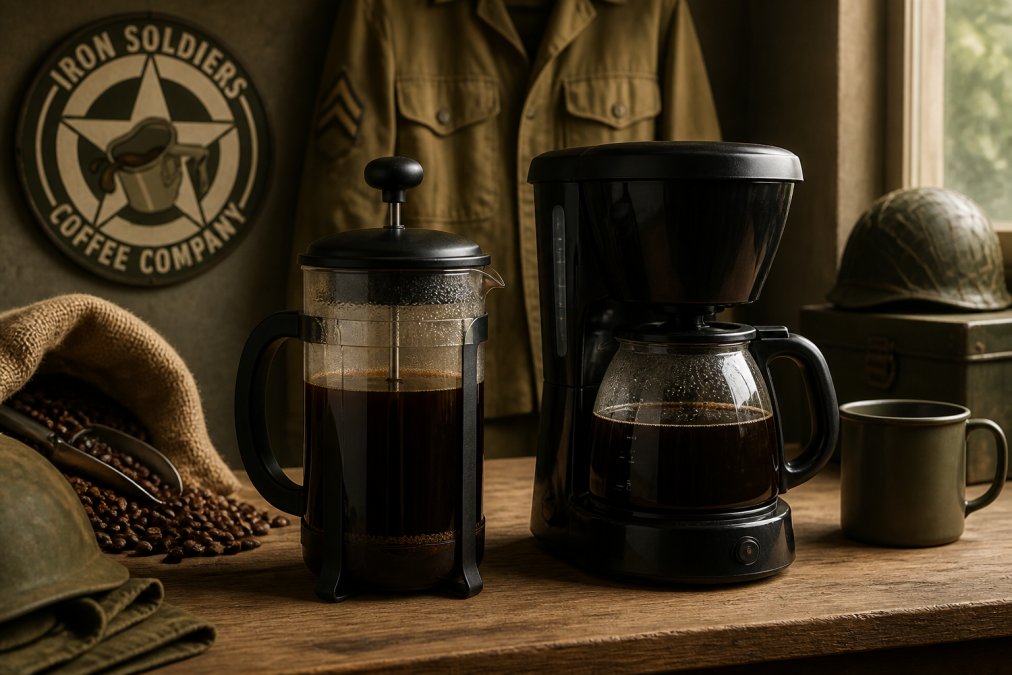
The mechanics matter more than brand loyalty. Immersion keeps grounds and water in full contact for the entire steep, so more oils and caffeine end up in your cup. Percolation passes water through the bed once, that single pass is why drip tastes cleaner and extracts less.
Immersion Brewing vs Percolation: How Each Method Works
Immersion brewing steeps grounds fully submerged for a set time before separating them with a filter. Percolation runs water through the grounds under gravity in a single pass.
In a French press, coarse grounds and hot water sit together about four minutes, then the plunger presses the mesh filter down through the slurry. Extraction continues the entire time water touches coffee, making steeping time your main strength lever.
Drip machines invert that logic. Water showers over the grounds in a basket, then drains through a paper filter into the carafe. Contact time is short, a predictable, repeatable brew with less room for error, but also less room for the deep, heavy extraction a French press delivers.
Paper Filter vs Metal Mesh Filter
The filter decides what reaches your mug. A metal mesh filter lets coffee oils and fine particles through, giving French press coffee its full-bodied, almost syrupy mouthfeel. A paper filter traps those oils and most fines, producing a clean cup with sharper flavor clarity.
That trade-off has a health angle: coffee oils contain diterpenes, compounds paper filters capture and metal mesh filters do not. For most daily drinkers this is minor, but it is one more reason drip tastes lighter and French press richer.
Metal mesh also means sediment, a fine layer of coffee fines at the bottom of your cup, especially with an inconsistent grind. Paper filters eliminate that.
Flavor Profile: Bold, Full-Bodied French Press vs Clean Drip
French press coffee delivers a bold, full-bodied profile with heavy mouthfeel and pronounced bitterness from the oils and fines that survive the mesh. Drip produces a cleaner cup with brighter acidity and more flavor clarity, but less body.
Neither profile is "better." They suit different missions. If you drink coffee for weight and warmth, the press wins. If you want the origin character of a single origin bean, the paper filter gets out of the way.
One thing most guides miss: strength and flavor intensity are not the same. A drip brew can be strong in caffeine while tasting thin, and a French press can taste heavy while extracting less efficiently. Strength is a ratio problem. Body is a filtration problem. Keep them separate and your brews improve.
The Best Coffee Grind for French Press (and Why Drip Needs a Different Grind)
The best coffee grind for french press is coarse, roughly the texture of sea salt, because fine particles slip through the metal mesh and turn your cup gritty. Drip brewing needs a medium grind between coarse and fine.
Grind size is not a flavor preference. It is a surface-area decision. Halve the particle size and you roughly double the surface area exposed to water, accelerating extraction. In a French press that acceleration is wasted, you are already steeping four minutes, so finer grounds just over-extract into bitterness and clog the mesh. In a drip basket, water contacts the bed only briefly, so too coarse a grind leaves flavor and caffeine locked inside. Same bean, same water, different extraction curve.
Here is the practical breakdown:
| Method | Grind Size | Approx. Particle Size | Filter Type | Typical Steep/Brew Time | Result |
|---|---|---|---|---|---|
| French press | Coarse | Roughly 800-1,000 microns, like sea salt | Metal mesh | 4 minutes | Full-bodied, some sediment |
| Drip | Medium | Roughly 600-800 microns, like table salt | Paper | 4-6 minutes total cycle | Clean, low sediment |
Those micron ranges are working targets, not laboratory absolutes. The two methods sit in adjacent bands, and moving one notch either direction changes the cup more than most brewers expect.
Grind consistency matters more than grind size. A burr grinder crushes beans between two hardened surfaces set to a fixed gap, so every particle exits at roughly the same dimension. A blade grinder shatters beans randomly, producing boulders and dust in the same batch. That dust is the enemy on both rigs: it clogs paper filters and stalls the drip cycle, over-extracts into harsh bitterness, and slips past a French press plunger to grit up the last inch of your mug. Switch from blade to burr and the difference in flavor clarity is not subtle.
Match the grind to the mission. If your French press cup tastes weak, go slightly finer plus a longer steep, not more coffee. If it tastes bitter and muddy, go coarser and press more slowly. If your drip coffee tastes thin, tighten the grind one notch before touching the ratio; the shorter contact time makes grind your most sensitive lever. If it tastes harsh or the basket overflows, loosen it. One variable at a time.
Pro Tip
Dial in grind before you dial in ratio. A coarse grind with a strong ratio still tastes weak because the water cannot reach the interior of the particle. Fix the particle size first, then adjust the dose.
A final note on burr grinders: the setting that works for one bean will not always work for the next. Darker roasts are more brittle and shatter finer at the same setting; lighter roasts are denser and need a notch finer to extract fully. Recalibrate when you open a new bag.
French Press Brewing Ratio: Dialing In Strength by the Numbers
The french press brewing ratio is the single biggest lever you control, and most home brewers run it too weak. A strong starting point is 1:12, one part coffee to twelve parts water by weight. For a 12-ounce mug, that means roughly 28 grams of coffee to 340 grams of water.
Scale from there: 1:15 for a balanced everyday cup, 1:10 for a heavy, syrupy brew. Weigh your coffee. Scoops vary wildly and volume-based measuring is the fastest way to an inconsistent cup.
For drip, ratios sit in a similar band, usually 1:15 to 1:17. Drip machines are less forgiving of a weak ratio because the short contact time cannot compensate. If your drip coffee tastes watery, add coffee first.
Pro Tip
Weigh your water too, not just your coffee. A "full" mug holds different amounts depending on the mug, and eyeballing water volume is the quiet reason two identical recipes taste different on consecutive mornings.
How to Make Strong Coffee at Home: Water Temperature, Time, and TDS
Learning how to make strong coffee at home comes down to three variables: water temperature, contact time, and total dissolved solids. Each behaves differently depending on whether you are steeping or percolating, and that difference is where strength is won or lost.
Water temperature should land between 195°F and 205°F. Water off a rolling boil is too hot and scorches the grounds into harsh bitterness. Let the kettle rest about 30 seconds after boiling, or use a thermometer. The Specialty Coffee Association brewing standards treat this range as the baseline for proper extraction.
Here is the nuance most guides skip: temperature does not act the same way in both methods.
Watch Out
Do not chase strength with temperature. Water above 205°F does not extract more caffeine, it extracts more bitterness. If your cup is weak, fix the ratio or the grind, not the kettle.
Caffeine, Sediment, and Consistency: What Actually Changes the Cup
Watch Out
The most common French press mistake is plunging too fast. Slamming the plunger down stirs up the fines and pushes grit straight through the mesh, turning a clean brew into a muddy one. Press slowly, with steady pressure, and stop the moment you feel real resistance.
Pros and Cons: French Press vs Drip at a Glance
Key Takeaway
If strength is your mission, the French press gives you more control over extraction. If consistency is your mission, drip wins. Most serious home brewers keep both and pick based on the morning.
Frequently Asked Questions
Does a French press produce stronger coffee than a drip machine?
Yes, when brewed with the same coffee-to-water ratio, a French press typically produces a stronger cup. Immersion brewing keeps all the coffee oils and fine particles in the cup, while paper-filter drip machines trap many of those compounds. The metal mesh filter in a French press lets more sediment and oils through, giving you a heavier body and more intense flavor per sip.
How does the grind size affect the strength of my morning brew?
Grind size controls how fast water extracts flavor from the coffee. A coarse grind is the best coffee grind for french press because it slows extraction and prevents clogging the mesh filter. Too fine a grind leads to over-extraction, bitterness, and muddy sediment. For drip, a medium grind works best because the paper filter and shorter contact time require faster extraction.
Is the oil content higher in French press coffee?
Yes. French press coffee retains more coffee oils because the metal mesh filter does not absorb them the way paper filters do. Those oils carry much of the flavor and body you taste, which is why French press coffee often feels richer and more full-bodied. Drip coffee made with paper filters tastes cleaner but loses some of that oil-driven depth.
Which brewing method is better for a full-bodied cup of coffee?
French press wins for a full-bodied cup. The immersion method and metal mesh filter let more oils, sediment, and fine particles into the final brew, creating a heavier mouthfeel and bolder flavor. Drip coffee, especially with a paper filter, produces a lighter, clearer cup. If you want maximum body and strength, French press is the better choice.
Related post
10
Oct


08
Oct