Coffee Roast Level and Strength: What Decides Your Brew
Table of Contents
- The Impact of Coffee Roast Level on Strength: Debriefing the Basics
- Coffee Strength vs Caffeine: Two Different Missions
- Light Roast vs Dark Roast Flavor: The Taste Report
- Light Roast vs Dark Roast Caffeine: The Measured Truth
- Coffee-to-Water Ratio for Stronger Coffee: Your Field Manual
- How Roast Level Affects Flavor and Caffeine Across Brewing Methods
- Troubleshooting Weak or Bitter Coffee: Field Repairs
- Conclusion: Taking Command of Your Daily Ration
- Frequently Asked Questions
Last Updated: October 6, 2026
The Impact of Coffee Roast Level on Strength: Debriefing the Basics
Coffee strength is how much dissolved coffee material ends up in your cup, and roast level plays a supporting role, not the lead. The bigger drivers are dose, grind, and water.
Here is the part most guides skip: roast level changes flavor far more than it changes caffeine. A dark roast tastes bolder because roasting builds new aromatic compounds. It does not automatically deliver more caffeine per scoop.
Two definitions worth locking in before we move:
- Coffee strength is the concentration of dissolved coffee solids in your brewed cup.
- Extraction is the process of hot water pulling soluble material out of ground coffee.
Keep those separate and the rest of this debate gets much simpler.
Key Takeaway
Roast level shapes taste. Your recipe shapes strength. Fix the recipe first, then dial in the roast to match the flavor you want.
Coffee Strength vs Caffeine: Two Different Missions
Strength and caffeine are two separate missions, and treating them as one is the most common error we see. Strength is about concentration in the cup.
You can brew a weak-tasting cup that still carries a real caffeine load. You can also brew a bold, heavy cup with less caffeine than you expect.
So what actually decides strength? Three things:
- How much ground coffee you use (the dose)
- How fine you grind it (grind size)
- How much water you run through it (water amount)
Caffeine follows its own rules. It depends on the coffee dose, the bean itself, and how much you actually drink. A bigger serving size means more caffeine, even from the same brew.
Watch Out
Do not chase a caffeine boost by switching to a darker roast. You will change the flavor and get roughly the same caffeine. Increase the dose instead.
Light Roast vs Dark Roast Flavor: The Taste Report
Flavor is where roast level earns its paycheck. A light roast keeps more of the bean's origin character: bright acidity, fruity notes, a lighter body. A dark roast trades that away for roasted flavor: smoky, bittersweet, sometimes a touch of char.
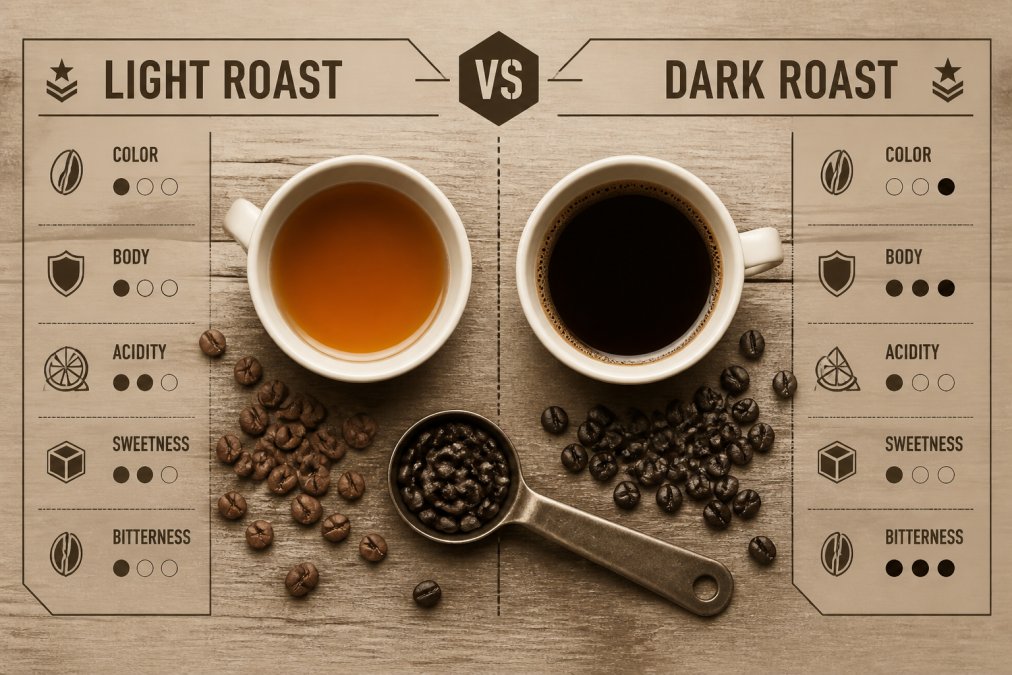
Here is how the two compare in the cup.
| Factor | Light Roast | Dark Roast |
|---|---|---|
| Flavor focus | Origin, fruit, acidity | Roast, smoke, cocoa |
| Body | Lighter | Heavier |
| Bitterness | Lower | Higher |
| Aroma | Bright, floral | Deep, toasted |
| Best for | Pour-over, drip | Espresso, French press |
A dark roast can taste bolder and more intense without being stronger in the technical sense. The roasting process creates those heavy, roasted notes, and your palate reads them as power. That is flavor intensity, not brew strength.
Light Roast vs Dark Roast Caffeine: The Measured Truth
Caffeine barely budges with roast level. The bean's caffeine content is largely set before roasting even starts, so light and dark beans of the same origin land close together.
The confusion comes from measuring by volume. Dark beans lose moisture and gain size during roasting. They also become more porous and less dense. So a scoop of dark beans weighs less than a scoop of light beans.
Less bean weight per scoop means less caffeine per scoop. Measure by weight and the gap mostly closes.
- By weight: light and dark roast caffeine lands close
- By volume: dark roast often delivers less caffeine per scoop
- By cup: serving size decides the final dose
Pro Tip
Weigh your coffee on a kitchen scale in grams. It is the single fastest fix for inconsistent caffeine and inconsistent taste.
Coffee-to-Water Ratio for Stronger Coffee: Your Field Manual
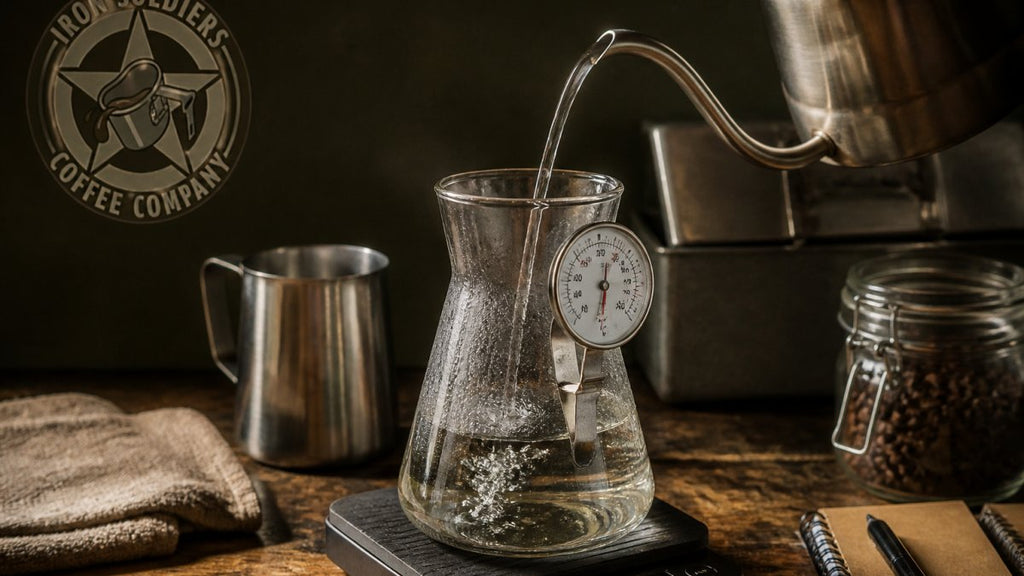
The coffee-to-water ratio is your main strength control, and it beats roast level every time. A good starting point is 1 gram of coffee to 16 grams of water. Want it stronger? Drop toward 1:15 or 1:14.
Here is a repeatable way to adjust brewed strength:
- Start at 1:16 and brew a cup you know.
- If it tastes weak, tighten the ratio to 1:15.
- Still weak? Go to 1:14 before touching anything else.
- If it turns bitter, back off toward 1:16 and check your grind.
- Keep the dose fixed and change only one variable per brew.
That last step matters. Change one thing at a time, or you will never know what worked. The Specialty Coffee Association brewing standards offer a solid reference for ratio and extraction targets if you want a benchmark to aim at.
How Roast Level Affects Flavor and Caffeine Across Brewing Methods
Roast level does not act alone. It reports for duty inside a brewing method, and each method has its own extraction profile, grind size, water temperature, contact time, and pressure. Change the method and the same bean reports a different flavor. Here is how roast choice interacts with each major method, plus what stays constant on the caffeine front.
Espresso
Espresso runs hot and fast: roughly 200°F water, 9 bars of pressure, a fine grind, and a 25-30 second pull. That short, pressurized contact rewards darker roasts. The roast's developed sugars and roasted notes extract quickly, producing a syrupy, low-acid shot with heavy body. Light roasts can work in espresso, but they often taste sharp or underdeveloped unless you grind finer, raise the water temperature slightly, and pull longer. The roast is not the variable that decides strength here, the dose and yield do.
Pour-Over
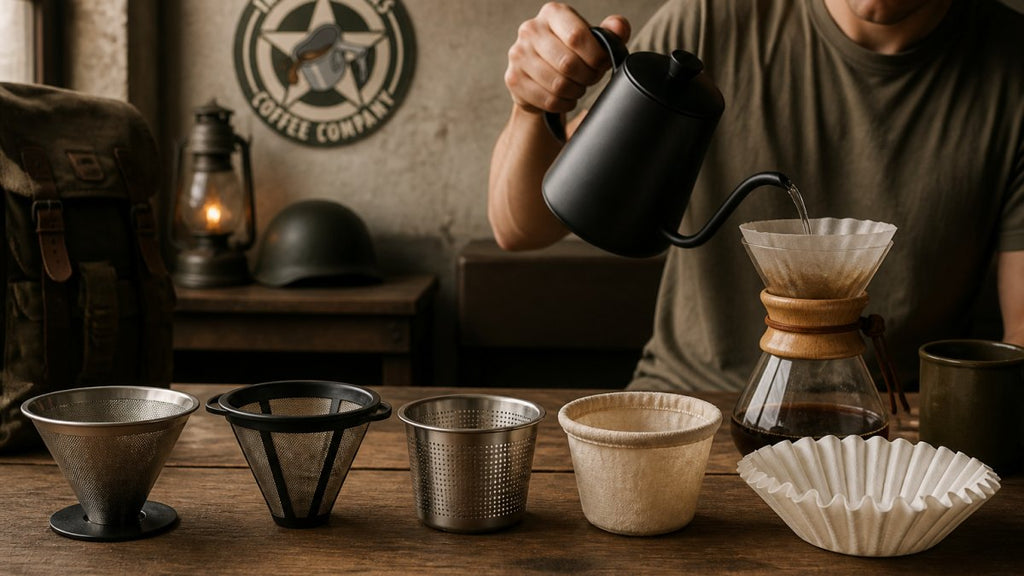
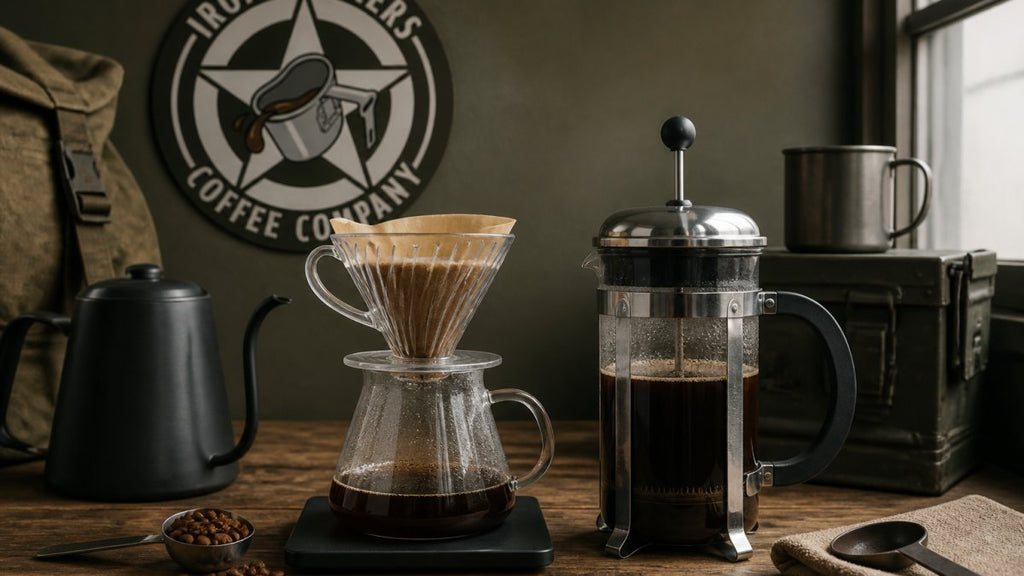
Pour-over is a percolation brew: medium grind, 195-205°F water, and a total contact time around 2:30 to 3:30. The paper filter traps oils, so the cup reads clean and bright. Light and medium roasts shine here because their origin character, fruit, floral, acidity, survives the filter. Dark roasts can taste flat or ashy in a pour-over because the filter strips the heavy oils that carry their roasted sweetness. If you brew dark in a pour-over, shorten the ratio slightly and keep the water on the cooler end.
French Press
French press is full immersion with a metal mesh filter, so oils and fine particles stay in the cup. Coarse grind, 195-205°F water, and a 4-minute steep. Dark roasts hold up well because their heavy body matches the brew's texture. Light roasts can taste thin or tea-like unless you grind finer and extend the steep. Because the mesh lets sediment through, French press tends to read as "stronger" on the palate even when the measured concentration is identical to a pour-over.
Cold Brew
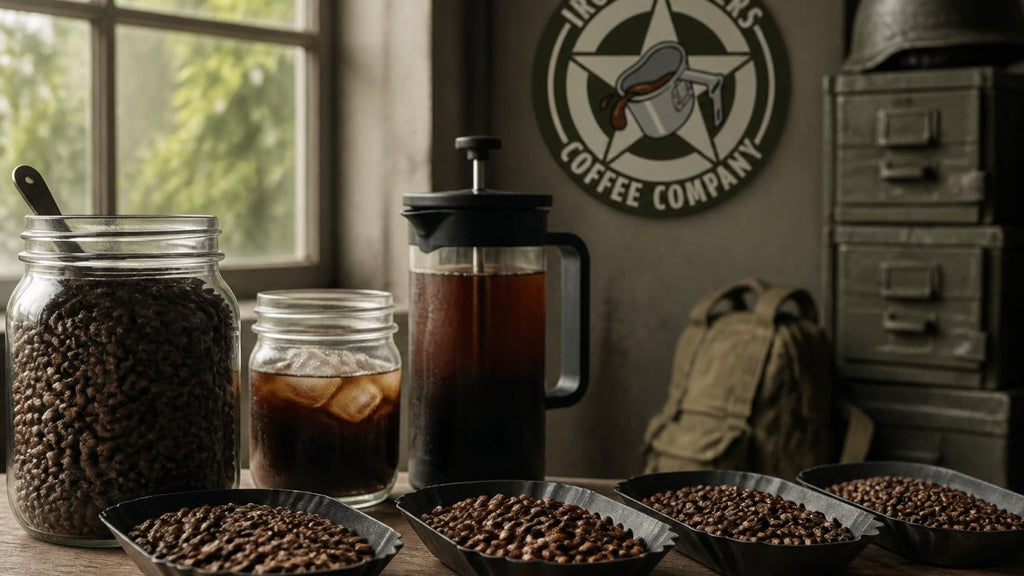
Cold brew is a long, cold immersion, coarse grind, room-temperature or cold water, and a 12-18 hour steep. The low temperature slows extraction of acids and bitter compounds, so the cup reads smooth and low-acid regardless of roast. Dark roasts contribute cocoa and toasted notes; light roasts contribute fruit and brightness. Cold brew concentrate is typically diluted 1:1 to 1:3 with water or milk before serving, which means the strength you taste depends far more on your dilution ratio than on the roast.
What Stays Constant: Caffeine
Across all four methods, roast level barely moves the caffeine needle. What moves it is the dose, the serving size, and how much water actually contacts the grounds. A 2-ounce espresso shot and a 12-ounce drip cup can carry similar caffeine if the drip dose is small and the espresso dose is large. Method changes the flavor and the texture; the roast changes the flavor; the recipe changes the strength and the caffeine dose.
Key Takeaway
Pick the roast to match the method's extraction profile, then tune dose, grind, and time to hit the strength you want. Roast is the flavor lever. The recipe is the strength lever.
Troubleshooting Weak or Bitter Coffee: Field Repairs
Weak or bitter coffee almost always traces back to the recipe, not the roast. But "fix the recipe" is not a plan. You need a diagnostic order, because strength problems and extraction problems look similar on the tongue but require opposite corrections. Run this field protocol before you blame the beans.
Step 1: Separate Strength From Extraction
Ask one question first: does the cup taste diluted, or does it taste wrong?
- Diluted means the concentration is too low. The coffee tastes watery but not harsh. This is a strength problem, fix the ratio or the dose.
- Wrong means the extraction is off. The cup tastes bitter, sour, or hollow even at a normal concentration. This is an extraction problem, fix the grind, temperature, or time.
Confusing these two is the most common error. Adding more coffee to a bitter cup makes it worse, because bitterness signals over-extraction, and more coffee means more over-extracted material.
Step 2: Run the Diagnostic
| Taste outcome | Likely cause | First adjustment |
|---|---|---|
| Weak and watery | Ratio too loose | Tighten ratio toward 1:15, then 1:14 |
| Bitter and harsh | Over-extraction | Grind coarser, or shorten brew time |
| Sour and thin | Under-extraction | Grind finer, or extend brew time |
| Flat and lifeless | Stale beans or low dose | Check roast date; increase dose |
| Inconsistent cup to cup | Volume measuring | Switch to a gram scale |
| Harsh but not bitter | Water too hot | Drop water temperature toward 195°F |
Step 3: Change One Variable at a Time
This is the discipline that separates a repeatable cup from a lucky one. Change one thing, brew, taste, and log the result. If you change grind and ratio together, you will never know which one fixed the cup.
A practical order of operations:
- Lock the dose on a scale.
- Lock the water amount.
- Adjust grind to fix extraction (sour vs bitter).
- Adjust ratio to fix strength (weak vs strong).
- Adjust water temperature last, and only if the first four steps stall.
Step 4: Know When It Is the Bean, Not the Brew
If the cup is flat no matter how you adjust, the problem is likely the coffee itself. Fresh-roasted beans degas for a few days after roasting and hit their best flavor window roughly 4 to 14 days off the roast for most brewing methods. Beans past their prime lose aromatic compounds and read as papery or stale. No grind adjustment fixes stale coffee.
Watch Out
Do not fix bitterness by adding more coffee. Bitterness is a signal of over-extraction. More coffee means more over-extracted material, and the cup gets harsher, not smoother.
Pro Tip
Keep a brew log. Dose, water, grind setting, time, and a one-word taste note. After a week you will see the pattern, and you will stop guessing.
Conclusion: Taking Command of Your Daily Ration
Your daily ration deserves a clear plan of attack. Roast level sets the flavor profile. Your dose, grind, and ratio set the strength. Keep those jobs separate and you will brew a better cup every single time.
At Iron Soldiers Coffee Company, we roast for people who take their coffee seriously. Our Sherman Tank Edition brings a bold dark roast with notes of cocoa and toasted nuts.

Shop All Coffee and take command of your next brew.
Frequently Asked Questions
Does a darker roast mean stronger coffee?
Not in caffeine terms. Darker roasting drives off some caffeine as beans lose mass, so by weight a dark roast can carry slightly less caffeine than a light roast. What dark roast does deliver is bolder flavor intensity: more body, more bitterness, and a heavier mouthfeel. If strength means taste, dark wins. If strength means caffeine per scoop, measure by weight and expect the difference to be small.
Does light roast or dark roast have more caffeine?
By weight, light roast generally holds a little more caffeine because beans lose mass during roasting while caffeine stays largely intact. By volume, the picture flips: dark beans are larger and less dense, so a scoop of dark roast weighs less than a scoop of light roast and can deliver less caffeine. Weigh your dose in grams for a consistent per-cup caffeine estimate instead of trusting a scoop.
Does the brewing method affect coffee strength more than roast level?
Yes. Your coffee-to-water ratio, grind size, water temperature, and contact time move brew strength far more than roast level does. A dark roast brewed at 1:15 will taste stronger than a light roast brewed at 1:18, and a fine grind in a French press can turn any roast bitter. Nail your ratio and grind first, then adjust roast level to fine-tune flavor.
How do I make my coffee stronger without changing the roast?
Tighten the ratio before you change anything else. Move from 1:17 toward 1:15 or 1:14, meaning roughly 15 to 17 grams of water per gram of coffee. Next, grind finer in small steps, since more surface area extracts more flavor. Keep water between 195 and 205 degrees Fahrenheit and extend contact time slightly. Change one variable at a time and taste after each adjustment.